Phaedo
by Plato · Φαίδων
Assigned by 7 of the 9 reading lists
- Written
- c. 380 BCE
- Language
- Greek
- Length
- Short · 90 ppunder 120 pages
- Difficulty
- Demanding3 of 5 for a first-year reader
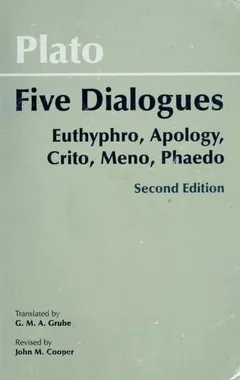
We recommendFive Dialogues, translated by G. M. A. Grube, revised by John M. CooperHackett, 2002The standard classroom translation, bound with the Apology and Crito that lead up to it.
Also good
- David Gallop. A philosopher's translation with a commentary that takes the arguments apart properly.
- Christopher Rowe. Groups the four trial and prison dialogues in narrative order, which is how the story reads best.
These links go straight to Amazon and Bookshop.org and earn this site nothing today. Prices are the same either way. How this works.
Some years after the event, Phaedo describes to Echecrates the last day of Socrates' life, spent in prison with a dozen friends while the executioner waits. Socrates argues that a philosopher should welcome death, and then offers arguments that the soul survives it: that opposites come from opposites, that learning is really the recovery of knowledge we had before birth, that the soul resembles the changeless realities rather than the changing body, and finally that the soul cannot admit death any more than the number three can admit evenness. Simmias and Cebes press serious objections. Socrates ends with a myth of the earth and the afterlife, bathes, drinks the hemlock and dies.
Why it's on the list
The Phaedo is where the theory of Forms is first laid out as a working piece of metaphysics rather than gestured at, and where the soul becomes the immaterial, immortal thing that Western philosophy and Christian theology will argue about for the next two thousand years. It is also the founding text of a particular picture of the philosophical life, in which thinking is practice for dying and the body is an obstacle. Nietzsche attacked it on exactly those grounds. Programs assign it for two reasons at once. It contains four arguments compact enough to be evaluated by a beginner, and it contains a death scene that makes the arguments matter, since the man advancing them is about to find out whether they are true.
Key themes
- Death and mortality
- Death is treated as a separation of soul from body, and therefore as the thing the philosopher has been rehearsing all along.
- The self and identity
- What you really are, on this account, is the part of you that thinks, and your body is closer to a hindrance than to a home.
- Knowledge and truth
- The recollection argument makes learning a kind of remembering, which requires that the soul existed before the body it now occupies.
- Virtue and character
- Socrates distinguishes real courage and moderation from the calculating sort, where one fear is traded off against another.
- God and faith
- The closing myth is offered as likely rather than proved, and Socrates says so, which raises the question of what myth is doing in a work of argument.
Overview
The Phaedo is a report of a conversation, told by a man who was there to a man who was not. That frame matters. Phaedo is recounting the day for people in another city who want to know how Socrates died, and his narration keeps interrupting the philosophy with details of the room: who wept, who sat where, when Xanthippe was sent away, how the jailer behaved.
So the dialogue has two things going on and they are meant to strain against each other. One is a technical debate about whether the soul is immortal, conducted with real rigour and including objections that Socrates cannot easily answer. The other is a death, described with almost clinical restraint. Plato put them in the same text because the first is only interesting if the second is happening.
It is also the dialogue in which the Forms do heavy work. The Beautiful itself, the Equal itself, the Just itself: these are treated as things that exist, that never change, and that the things around us are named after because they somehow participate in them. Socrates calls this his hypothesis and offers it as what he has to go on. Whether Plato thinks it proved or thinks it the best available account is one of the durable arguments about the dialogue.
Read it after the Apology and Crito if you can. The three are set in sequence, and the Phaedo assumes you already know why Socrates would not run.
The argument
The opening movement, from 59 to 69, defends the claim that philosophers should not fear death. If what a philosopher wants is to grasp things as they are, and if the senses distort and the appetites distract, then the state in which the soul is by itself is the state a philosopher has been wanting. Suicide is nonetheless forbidden, since we are not our own to dispose of. Socrates also redescribes ordinary virtue as a trade in fears and pleasures, and insists that real virtue comes with knowledge.
Then four arguments. The cyclical argument, from 70 to 72, notes that opposites come to be from their opposites: the larger from the smaller, the waking from the sleeping. If living comes from dead, souls must exist somewhere in between. The recollection argument, from 72 to 77, observes that we recognise imperfect equals as falling short of equality itself, which we never encountered through the senses, so we must have known it before birth. The affinity argument, from 78 to 80, sorts things into the composite and changing, which scatter, and the simple and changeless, which do not, and places the soul with the second group.
Simmias and Cebes then object, and their objections are the best part of the dialogue. Simmias proposes that the soul is an attunement of bodily elements, which would make it real, fine and utterly perishable. Cebes grants that the soul is durable and long-lived and asks whether it might still wear out after many bodies, like a tailor outliving many coats but not immortal for that.
The company falls silent, and Socrates warns them against becoming haters of argument. He answers Simmias by pointing out that an attunement admits of degrees while a soul does not, and that a tuning cannot oppose its instrument while a soul opposes the body constantly. Answering Cebes takes him through an intellectual autobiography, his disappointment with the natural philosophers who explained everything by material causes and never by what is good, and then to the final argument at 102 to 107: a Form excludes its opposite, and things that participate in a Form exclude it too, so since soul brings life, soul cannot admit death.
The myth at 108 to 114 describes a vast earth of which we inhabit a hollow, with a true surface above, and sorts the dead by how they lived. Socrates presents it as worth believing rather than as demonstrated. Then the bath, the family, the jailer’s apology, the drink, the walking until his legs grow heavy, and the last instruction about a debt.
How to read it
Read the frame and the death scene first if you like, then go back for the arguments. Many readers find the reverse order kills the momentum, because the technical stretch from 102 onward is hard going.
Number the four arguments and write down what each one would have to assume to work. Then ask of each what it proves. Several of them establish only that the soul existed before, or that it lasts a long time, which is not the same as immortality, and Cebes says so. Plato does not hide this.
Take the objections seriously, and notice that Socrates’ answer to Simmias is much stronger than his answer to Cebes. Notice too how much of the final argument depends on accepting the Forms, and that nothing in the dialogue argues for them.
The common misreading is that the Phaedo teaches contempt for the body as such. What Socrates says is more specific: bodily needs interfere with sustained thinking. Whether that adds up to contempt is a fair question to put to the text, and Nietzsche’s answer is not the only one available.
Grube for class, Gallop if you want a commentary that will not let you off the hook.
Questions it raises
- Do any of the four arguments prove immortality, or only pre-existence and durability?
- Cebes’ coat objection is never fully answered. Is the final argument a reply to it or a change of subject?
- Why does a dialogue devoted to proof end with a myth that Socrates declines to call true?
- If the soul is what thinks, and thinking is best done without a body, what is the body for?
- Socrates says the philosopher practises dying. Is that a description of intellectual life or an argument against enjoying anything?
- The friends weep and Socrates rebukes them. Is their grief a failure of reasoning, or evidence against his position?
Highlights
Crito, I owe a cock to Asclepius; will you remember to pay the debt?
A debt owed for a cure. Readers have argued ever since about what has been cured.
I deem that the true votary of philosophy is likely to be misunderstood by other men; they do not perceive that he is always pursuing death and dying.
The claim the rest of the dialogue has to earn.
Socrates tells Cebes that what puts the soul in danger is not the body's weakness but hatred of argument, and warns the company against giving up on reasoning because one argument has failed.
Paraphrase.
Simmias objects that the soul may be to the body what a tuning is to a lyre, in which case it would be destroyed when the instrument is broken.
Paraphrase.
When the poison reaches his waist Socrates uncovers his face, speaks to Crito about the debt, and after a moment does not answer again.
Paraphrase.