Apology
by Plato · Ἀπολογία Σωκράτους
Assigned by 8 of the 9 reading lists
- Written
- c. 395 BCE
- Language
- Greek
- Length
- Short · 40 ppunder 120 pages
- Difficulty
- Approachable1 of 5 for a first-year reader
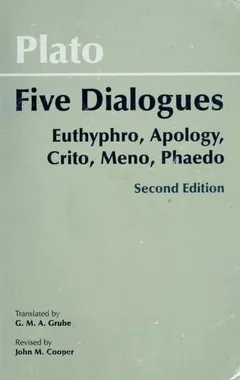
We recommendFive Dialogues, translated by G. M. A. Grube, revised by John M. CooperHackett, 2002Clear, accurate and cheap, with Euthyphro, Crito, Meno and Phaedo in the same volume.
These links go straight to Amazon and Bookshop.org and earn this site nothing today. Prices are the same either way. How this works.
Socrates' speech in his own defence at his trial in Athens in 399 BCE, on charges of impiety and corrupting the young. He deals first with the old rumours about him, then cross-examines his accuser Meletus, and explains that the Delphic oracle's verdict that no one was wiser than he set him questioning the city's supposed experts and made him hated. He refuses to stop philosophising or to beg, since a life without examination is not worth living for a human being. Convicted, he proposes that Athens feed him at public expense, then a small fine. Sentenced to death, he tells the jurors why they should not pity him.
Why it's on the list
This is the founding scene of philosophy as a way of life rather than a body of doctrine, and the founding case in the argument between the thinker and the city. A democracy tried a man for asking questions and killed him by a vote, and every later defence of free inquiry, from Milton to Mill to the campus quarrels of this week, is working in its shadow. It is also the only extended portrait we have of Socrates in public, defending not a theory but a habit: that you should find out whether you know what you claim to know. Programs put it early because it is short, because it is gripping, and because it forces the question that the rest of the shelf keeps returning to: is a good life something you can be talked out of?
Key themes
- Knowledge and truth
- Socratic wisdom here is purely negative. He is wiser than the politicians and poets only because he does not think he knows what he does not know.
- Justice
- The trial is legal and the verdict is lawful, which is exactly the problem. Socrates makes Athens choose between its procedures and its own good.
- Death and mortality
- He argues that death is either nothing or a change of address, and that fearing it is another case of claiming knowledge you lack.
- Power and authority
- He obeys the god over the jury, and cites two occasions when he refused an unlawful order, once under the democracy and once under the Thirty.
- Virtue and character
- His mission is to argue that money and reputation do not produce excellence, and that excellence is what produces everything else worth having.
Overview
In 399 BCE an Athenian jury of several hundred citizens heard a capital case against a seventy-year-old man accused of not believing in the city’s gods, of introducing new divinities, and of corrupting the young. Plato says he was present. What he wrote, some years later, is not a transcript. It is a speech in three parts that follows the real shape of an Athenian trial while making every word do philosophical work.
The Greek title is misleading in English. An apologia is a defence, not an admission, and Socrates apologises for nothing. The tone is the surprise of the book: he is funny, rude, patient and completely unwilling to do the ordinary things defendants did, which were to weep, to produce their children, and to appeal to the jury’s sympathy. He tells them plainly that he will not, and that he thinks they are being asked to do something shameful.
It is forty pages, and it is the single best place to start on the Greek philosophical shelf. You need no background. The argument is in the situation.
The argument
The speech has three movements, matching the three stages of the trial.
First, the defence proper. Socrates separates the charge he is answering from the reputation behind it. There are old accusers, he says, whom he cannot cross-examine: the people who have been telling Athenians for decades that Socrates studies things in the sky and below the earth and makes the weaker argument the stronger. He names Aristophanes, whose comedy Clouds had put a version of him on stage. Against that rumour he tells the story of the oracle. His friend Chaerephon asked at Delphi whether anyone was wiser than Socrates, and the priestess said no. Knowing himself to be ignorant, Socrates set out to refute the god by finding a wiser man, and examined politicians, poets and craftsmen in turn. The politicians thought they knew and did not. The poets made beautiful things they could not explain. The craftsmen really did know their trades and concluded from that that they knew everything else. His conclusion is that the god meant human wisdom is worth little, and that he is wiser only in not pretending.
Then he turns to Meletus and cross-examines him in front of the jury, which was permitted. He gets Meletus to say that he alone corrupts the young and everyone else improves them, which is absurd for any skill, and then gets him to assert both that Socrates is an atheist and that he teaches new divine beings, which cannot both be true. The formal charges collapse, and Socrates says so, and says it will not matter.
The heart of the speech is what follows. He describes his questioning as a service commanded by the god and compares himself to a gadfly on a large and sluggish horse. He says he will not stop if acquitted, that he cannot be silent as a condition of release, and that Athens is more likely to be harmed by killing him than he is by being killed. He mentions his daimonion, the divine sign that has never once told him what to do, only stopped him, and notes that it did not stop him coming here today. He cites his two acts of political disobedience: refusing to put the Arginusae generals to an illegal collective vote under the democracy, and refusing the order of the Thirty to arrest Leon of Salamis.
Second movement. Convicted by a narrow margin, he must counter-propose a penalty against Meletus’ demand for death. He suggests that what he deserves is dinner in the Prytaneum, the honour given to Olympic victors. Under pressure from friends he offers thirty minae, which they will guarantee. This is where the line about the unexamined life falls, and it is what makes the second vote worse for him than the first.
Third movement. Sentenced, he addresses both halves of the jury. To those who condemned him he predicts that younger and harsher questioners will replace him. To those who voted to acquit he offers a consolation: death is either dreamless sleep or a migration to a place where he can cross-examine Homer and Odysseus, and neither is bad.
How to read it
Read it in one sitting, aloud if you can, because it is a performance. Then read it again asking a hostile question: is he defending himself or provoking them? Many careful readers think he chose this outcome, and the evidence is in the penalty speech.
Read Crito immediately afterwards. In the Apology Socrates says he would disobey a court that ordered him to stop philosophising; in Crito he refuses to escape because the laws have a claim on him. Working out whether those two positions are consistent is the standard seminar assignment for a reason.
Notice what the charges do not mention. Athens had just lost a long war, suffered an oligarchic coup, and been governed briefly by the Thirty, several of whom had been close to Socrates. An amnesty made the political grievance unsayable in court. Much of the trial is about something nobody is allowed to name.
Grube’s translation is the standard classroom text and is very plain. Jowett is free and available everywhere. Avoid summaries, since the book is shorter than most of them.
Questions it raises
- Is Socrates trying to be acquitted? If not, what is the speech for?
- Was Athens entitled to defend its religion and its young, and if not, what may a city defend?
- Socratic ignorance sounds humble. Is it, or is it a claim to a higher kind of expertise?
- He says he obeys the god rather than the jury. How is that different from any believer who will not obey the law?
- Does the argument that death is nothing to fear actually support his refusal to compromise, or is it a separate consolation?
- If philosophy is a service to the city, why did the city not recognise it as one?
Highlights
The unexamined life is not worth living for a human being.
The sentence comes at the worst possible moment, in the speech where he refuses exile and effectively asks for the death penalty.
I am very conscious that I am not wise at all; what then does the god mean?
Paraphrase of his response to the oracle brought back by Chaerephon. The puzzle, not the answer, is what sets his whole career going.
Neither I nor he knows anything fine and good, but he thinks he knows something when he does not, while I, if I do not know, do not think that I do.
The whole of Socratic ignorance in one sentence, delivered after a conversation with a politician.
Nothing bad can happen to a good man, either in life or in death, and his affairs are not neglected by the gods.
Paraphrase of his closing address to the jurors who voted to acquit.
You go to your homes now, and I go to die.
Paraphrase of the final lines, where he says that which of the two fates is better is known only to the god.