Crito
by Plato · Κρίτων
Assigned by 6 of the 9 reading lists
- Written
- c. 395 BCE
- Language
- Greek
- Length
- Short · 20 ppunder 120 pages
- Difficulty
- Approachable1 of 5 for a first-year reader
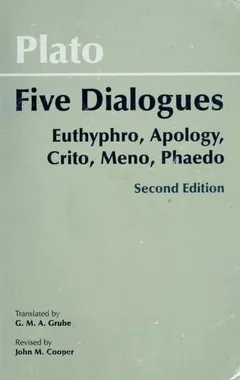
We recommendFive Dialogues, translated by G. M. A. GrubeHackett, 2002Revised by John M. Cooper and bound with the Apology, which Crito continues; reliable and inexpensive.
Also good
- G. M. A. Grube. Euthyphro, Apology, Crito and the death scene from Phaedo, which is the sequence most courses want.
- Christopher Rowe. A fresh translation with a substantial introduction on the legal background of the trial.
These links go straight to Amazon and Bookshop.org and earn this site nothing today. Prices are the same either way. How this works.
Socrates' old friend Crito visits him in prison before dawn and urges him to escape, saying the plan is ready, the bribes are affordable, and that staying will shame his friends and abandon his children. Socrates replies that the only question worth asking is whether escaping would be just, and that the opinion of the many is irrelevant to it. He establishes that one must never do wrong, not even in return for wrong, and then speaks in the voice of the Laws of Athens, who argue that he owes them his upbringing, his education and a lifetime's tacit agreement, and that breaking their judgments would destroy them. He stays.
Why it's on the list
This twenty-page conversation is where the West starts arguing about political obligation. Nearly every later theory of why citizens should obey, and of when they may refuse, engages the two arguments Socrates puts in the mouth of the Laws: that he has received benefits he cannot now disown, and that by staying in the city all his life he has tacitly agreed to its judgments. Locke's consent, Rousseau's contract, and modern debates about fair play all descend from those pages. The dialogue is also the standard foil for civil disobedience. King and Gandhi both invoke Socrates, which is awkward, because here Socrates refuses to break a law even when the law is killing him unjustly.
Key themes
- Justice
- Socrates gets Crito to agree that returning wrong for wrong is never permitted, which rules out escape as retaliation and is the hinge of the whole argument.
- Society and the state
- The Laws speak as parents and as parties to a contract, two analogies that pull in different directions. One makes obedience a debt, the other makes it a promise.
- Liberty and rights
- Athens allowed any citizen to leave with his property, and the Laws treat that open door as the proof of consent. Whether staying home counts as agreeing is the question the dialogue leaves live.
- Virtue and character
- Socrates argues that the soul can be damaged by wrongdoing as a body is damaged by bad food, so an unjust escape would harm him more than execution.
Overview
The Crito is about twenty pages and has two characters. It belongs to a sequence: the Euthyphro takes place before the trial, the Apology is the trial, the Crito is the month or so afterwards in prison, and the Phaedo is the day of the execution. Socrates was convicted in 399 BCE on charges of impiety and corrupting the young, and his death was delayed because a sacred ship had sailed to Delos and no execution could take place until it returned. Crito arrives at dawn with the news that the ship is expected, which means Socrates has a day or two.
The setting matters. Socrates is seventy, his escape has been arranged and paid for, the jailer has been managed, friends in Thessaly are ready to receive him, and nobody in Athens would have been surprised or particularly offended if he had gone. Wealthy men facing conviction often left. The dialogue is therefore not about whether escape is possible. It is about whether a man who has spent his life arguing that one should never act unjustly can make an exception for his own execution.
Plato structures it in two halves. First Socrates and Crito establish the principles together, in the usual question-and-answer form. Then Socrates does something he does nowhere else: he stops arguing in his own voice and delivers a long speech on behalf of the Laws of Athens, personified, who address him directly and accuse him.
The argument
Crito’s case comes first, and it is the ordinary decent one. People will think his friends were too cheap or too cowardly to save him. His sons will be orphaned and badly brought up. He was convicted unjustly, so the verdict has no claim on him. Time is short and the arrangements are made.
Socrates answers Crito’s reasons one at a time and then sets them aside as the wrong kind of reason. What most people will think is not evidence about what is right: in every skill we follow the one who knows rather than the many, and there is no reason to treat the care of the soul differently. Nor does the length of life matter, since the question is not how to stay alive but how to live well. That leaves one question: is escaping just?
Two premises settle it, and Crito agrees to both. One must never act unjustly. And, harder, one must never act unjustly even in return, so retaliation is out. Socrates notes that few people accept this second premise and that those who do not will have no common ground with those who do.
Then the Laws speak. Their argument comes in stages. If Socrates escapes, he attempts to destroy the laws and the city, since a verdict that individuals may nullify at will is no verdict. To this they add that he owes them more than a citizen owes an equal: they oversaw his parents’ marriage, his birth, his upbringing and his education, and a child may not strike a parent back. Then they shift from the language of debt to the language of agreement. Athens gave every young man who came of age the option to take his property and leave, without penalty, if he did not like the arrangements. Socrates never left, not once in seventy years except on military service. He made his life there and raised children there, which is the clearest possible endorsement. At his trial he could have proposed exile as his penalty and refused. Having accepted the benefits and declined every exit, he cannot now claim that the agreement does not bind him when it costs him something.
The Laws finish by warning him what escape would look like. He would arrive in a well-governed city as a known lawbreaker, or in a disorderly one where his talk about virtue would be a joke; his friends would risk exile; his children would be raised as foreigners. And he would face the judges in the next world having broken the very agreements he had spent his life defending.
Crito has nothing left to say. Socrates tells him the words are ringing in his ears like the flutes of the Corybantes, and that he must be allowed to follow where the god leads.
How to read it
Read the Apology first, in the same sitting if possible. Much of the Crito only registers if you have just heard Socrates tell the court that he would never stop philosophising even if ordered to, because that is a refusal to obey, and now he is refusing to disobey. Whether the two positions are consistent is the main question courses ask.
Read the speech of the Laws twice, and separate its threads. The parent argument, the benefits argument and the tacit consent argument are three different claims with three different weaknesses, and the speech slides between them. Notice also that Socrates does not make the speech himself. He reports what the Laws would say, which some readers take as a sign of distance.
Do not skip Crito’s opening. It is easy to treat him as a foil, but his reasons are the ones most people would give, and Socrates’ dismissal of what the many think is one of the places where students most often want to push back.
Grube’s Hackett translation, revised by Cooper, is the standard assignment and comes packaged with the other dialogues you will want. Rowe’s Penguin is the better introduction if you want the legal background of Athenian courts.
Questions it raises
- Does living in a city amount to agreeing to obey it? What would count as refusing?
- Socrates will not obey an order to stop philosophising but will accept an unjust death sentence. Is that a coherent position?
- The Laws compare themselves to parents and to partners in a contract. Can both analogies hold at once?
- If a verdict is unjust, what exactly does escaping destroy?
- Why does Plato have the Laws speak instead of Socrates? Does the device commit Socrates to everything they say?
- Could the arguments here be used to justify obedience to a tyranny? What resource does the dialogue offer against that?
Highlights
Then we ought not to retaliate or render evil for evil to any one, whatever evil we may have suffered from him.
The premise Crito concedes, and which decides the case before the Laws ever speak.
Socrates says that they should follow not the opinion of the many about what is just but the opinion of the one who understands it, as a man in training listens to his trainer rather than to the crowd.
Paraphrase of the opening argument about whose judgement counts.
The Laws ask Socrates whether he imagines a city can survive if private citizens may set aside the verdicts of its courts whenever they judge them wrong.
Paraphrase of the first speech of the Laws.
They remind him that he never left Athens except on campaign, that he chose to have children there, and that at his trial he could have proposed exile and did not.
Paraphrase. The argument from tacit agreement, stated in its sharpest form.