The Eumenides
by Aeschylus · Εὐμενίδες
Assigned by 3 of the 9 reading lists
The last play of the Oresteia. Orestes, having killed his mother, takes refuge at Delphi with the Furies asleep around him, ancient goddesses whose one function is to hunt down those who spill kindred blood. Apollo purifies him and sends him to Athens. There Athena refuses to judge the case herself, founds a court on the hill of Ares and empanels Athenian citizens to hear it. The Furies prosecute, Apollo defends, the jury splits evenly, and Athena's vote acquits. She then spends the rest of the play persuading the furious goddesses to accept a home and honours in Athens instead of blighting it.
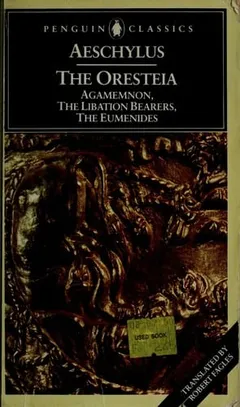
We recommendThe Oresteia, translated by Robert FaglesPenguin Classics, 1984Vivid and readable, with a long introduction and notes; contains all three plays of the trilogy.
Also goodcompare
- Richmond Lattimore. Literal where Fagles is theatrical, which matters in the trial scene where the arguments are technical.
As an Amazon Associate, The Great Books earns from qualifying purchases. Bookshop.org links also support this site. How this works.
- Written
- 458 BCE
- Form
- Tragedy
- Language
- Greek
- Length
- Short · 80 ppunder 120 pages
- Difficulty
- Demanding3 of 5 for a first-year reader
Robert Fagles translation
Buy on Amazon: The Eumenides, opens in a new tabBookshop.org: The Eumenides, opens in a new tab
Why it's on the list
This is the play where a blood feud becomes a legal system, and it is the founding myth of the jury trial. Two plays of killing that could not be stopped are resolved not by a stronger avenger but by taking the question out of the family's hands and giving it to twelve citizens and a secret ballot. Aeschylus produced it in 458 BCE, three or four years after Athens had stripped the Areopagus of almost all its powers in a violent political fight, so a jury in the audience was watching its own institution being given a divine charter. The ending is also the most argued-over in Greek drama: Apollo wins with an argument about biology that most readers find outrageous, and Athena's deciding vote is justified on grounds she states plainly and few people accept.
Key themes
- Justice
- The Furies represent an older order in which the act is all that matters and intention is irrelevant; Apollo represents a newer one that weighs motive and sanction. The court exists because neither can beat the other.
- Society and the state
- Athena's answer to a question too hard for a god is a procedure: a standing court, citizen jurors, both sides heard, a tie counted as acquittal. The trilogy's solution is institutional, not moral.
- Power and authority
- The Furies are older than the Olympians and say so repeatedly. What Athena offers them is not defeat but a portfolio, and the play insists that a city needs their fear inside it rather than banished.
- Family and inheritance
- Apollo argues that the mother is not a parent but the nurse of another's seed, and cites Athena's birth from the head of Zeus as proof. The case turns on whether killing a mother is kin-murder at all.
Which translation to read
For The Eumenides the translation is most of the decision. Our pick is the Robert Fagles translation; the other is good for different reasons.
Our pick
The Oresteia, translated by Robert Fagles
Penguin Classics, 1984
Vivid and readable, with a long introduction and notes; contains all three plays of the trilogy.
Amazon: the Robert Fagles translation, opens in a new tabBookshop.org: the Robert Fagles translation, opens in a new tab
Also good
Aeschylus I (The Complete Greek Tragedies), translated by Richmond Lattimore
University of Chicago Press, 2013
Literal where Fagles is theatrical, which matters in the trial scene where the arguments are technical.
Amazon: the Richmond Lattimore translation, opens in a new tabBookshop.org: the Richmond Lattimore translation, opens in a new tab
Overview
The Eumenides is the only surviving Greek tragedy whose third act is a court case, and the only one in which a chorus of monsters is talked into taking a job.
Two things make it unlike the plays before it. It moves: Delphi, then Athens, then a hillside, with a scene change in the middle, which Greek tragedy almost never does. And the chorus is not a group of bystanders commenting on other people’s disaster. The Furies are a party to the action, they prosecute, they lose, and the final third of the play is about what happens to them.
Ancient sources say the first appearance of the Furies caused pandemonium in the theatre, and although the details of that story are not reliable, the effect was clearly meant to be extreme. They are described as black, snoring, dripping, with snakes, and nobody had put anything like them on a stage.
The politics are immediate and deliberate. In 462 BCE the reformer Ephialtes had stripped the council of the Areopagus of nearly all its powers, leaving it with jurisdiction over homicide, and he was murdered shortly afterwards. Aeschylus staged this four years later, showing Athena founding that exact court for that exact purpose. What he meant by it, endorsement of the reform or a plea for what survived it, has been argued over ever since.
What happens
The priestess of Apollo at Delphi opens the play with a calm, formal prayer to the gods of the shrine, goes inside, and comes scrambling out on her hands and knees. There is a man at the navel-stone with blood on his hands, and around him a sleeping ring of creatures she has no name for.
Apollo wakes Orestes and admits responsibility: he ordered the killing, and he will not abandon him. He has put the Furies to sleep, which he says is the most he can do, and sends Orestes to Athens to embrace the ancient statue of Athena and find judges. Hermes will guide him.
Then the ghost of Clytemnestra, who does not appeal to anyone but simply wakes her hounds, reproaching them for sleeping while her killer runs. The Furies rouse themselves and quarrel bitterly with Apollo on his own threshold. Their case is a good one and they state it clearly: they hunt those who kill blood kin, that is all they do, and Clytemnestra’s crime was against a husband, who was no blood relation of hers. Apollo calls them disgusting and tells them to get out of his temple.
In Athens, Orestes clasps Athena’s statue and the Furies close in and sing the binding song, a hymn meant to tie him up in madness where he sits.
Athena arrives and does something unexpected: she asks questions, hears both sides, and then says the matter is too great for any one person to decide, herself included. She will appoint a court from the best of her citizens, bind it by oath, and make it permanent.
The trial is short and strange. The Furies cross-examine Orestes and he admits the act. Apollo appears as advocate and makes three arguments: that the oracle came from Zeus, that Agamemnon’s murder was the worse crime because he was a king and died shamefully in a bath, and finally the biological claim, that the mother does not generate the child but only carries another’s seed, so Orestes did not kill a blood relation at all. His proof is Athena, standing there, who had no mother.
Athena announces that she votes for Orestes, giving her reasons: no mother bore her, and she is for the father in all things. She rules that a tie acquits. The votes are counted and are equal. Orestes is free, thanks Athena, promises that Argos will be Athens’ ally forever, and leaves the play.
That is two thirds of the way through, and the remaining third is the part that matters. The Furies are not placated by a verdict. They are ancient, they have been overridden by younger gods, they have lost their function, and they promise to drop a poison on Attica that will kill crops and children. Athena does not threaten them, though she mentions twice that she knows where Zeus keeps the thunderbolt. She offers: a home in the earth beneath the city, sacrifices, first honours, a share in every marriage and birth, and a standing role as the thing Athenians are afraid of when they consider doing wrong. She makes the offer four times. They accept, their song turns from blight to blessing, and the trilogy that began with a man lying on a roof in the dark ends with a torchlit procession escorting them to their new home under a new name.
How to read it
Read the whole trilogy in sequence, and read this one in a single sitting. It is eighty pages and the shape only works entire.
Read the trial twice. The first time, follow who says what. The second time, notice how bad Apollo’s arguments are, and ask whether Aeschylus knew. Many readers conclude the verdict is meant to look thin, and that the real resolution is what Athena does afterwards rather than what the court decides.
Pay attention to the Furies’ own case. They are not evil and they are not stupid. Their song about fear as a necessary guard is a serious political argument, and Athena endorses it in her own charge to the jury a few hundred lines later.
Note what the settlement costs. The Furies keep their function and lose their independence; Orestes goes free on a technicality about parenthood; the mother’s claim is never actually answered. Whether that is a resolution or a suppression is the standing question.
Watch for the change of name. They become the Eumenides, the Kindly Ones, only at the very end, and the title of the play is therefore a piece of information withheld until the last minutes.
Questions it raises
- Apollo wins with the claim that the mother is not a parent. Does the play endorse that argument, or expose it?
- Athena breaks the tie by declaring herself for the father in all things. Is a judge who states that bias before voting giving a reason or an excuse?
- The court replaces the feud. What exactly has been solved, and what has only been moved somewhere else?
- The Furies are bought off with honours. Is that reconciliation, or the older order being absorbed and silenced?
- If a tie acquits, the system is designed to let the guilty go rather than punish the innocent. Is that the right setting?
- The trilogy ends in a procession and a blessing. Does the house of Atreus actually get peace, or only Athens?
Highlights
The mother is not the parent of what is called her child, but the nurse of the newly sown seed. The one who mounts is the parent.
Paraphrase of Apollo's decisive argument in the trial, which he supports by pointing at Athena, born from Zeus with no mother at all.
This is my ruling: a tie in the votes acquits the man.
Paraphrase of Athena's decision, delivered before the ballots are counted rather than after.
There is a place for fear, and it must sit as a guard over the mind. It profits a city to learn wisdom under constraint.
Paraphrase of the Furies' central song, which is not a threat but a political argument, and which Athena later repeats back to them as her own.
Neither anarchy nor tyranny: let my citizens hold to the middle, and never cast out fear altogether from the city.
Paraphrase of Athena's charge to the court as she founds it.