The Libation Bearers
by Aeschylus · Χοηφόροι
Assigned by 3 of the 9 reading lists
The middle play of the Oresteia. Years after Agamemnon's murder his son Orestes comes back from exile and meets his sister Electra at their father's grave, where Clytemnestra has sent her to pour offerings after a terrifying dream. They recognise each other and, with the chorus of captive women, call on the dead man to help them. Orestes enters the palace disguised as a stranger bringing news of his own death, kills Aegisthus, and then, after his mother bares the breast that fed him and he hesitates, kills her too. As he shows the bodies the Furies appear, visible to nobody but him, and he runs.
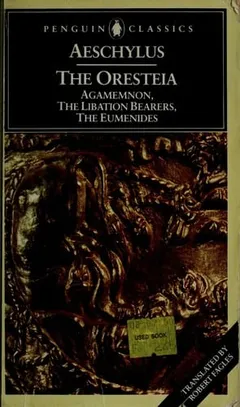
We recommendThe Oresteia, translated by Robert FaglesPenguin Classics, 1984Vivid and readable, with a long introduction and notes; contains all three plays of the trilogy.
Also goodcompare
- Richmond Lattimore. The literal version, and the one to check when Fagles has smoothed a difficult passage into something too easy.
As an Amazon Associate, The Great Books earns from qualifying purchases. Bookshop.org links also support this site. How this works.
- Written
- 458 BCE
- Form
- Tragedy
- Language
- Greek
- Length
- Short · 80 ppunder 120 pages
- Difficulty
- Demanding3 of 5 for a first-year reader
Why it's on the list
This is the play where the trilogy's problem becomes unbearable. In Agamemnon the killing could be defended as a mother's payment for a murdered daughter. Here the same logic requires a son to kill his mother, at the explicit order of Apollo, and Aeschylus makes sure you feel exactly how monstrous that is by giving Clytemnestra one gesture and four words that nearly stop it. Sophocles and Euripides each rewrote the recognition scene, and Euripides mocked this one by name, which tells you how central it had become. It is also the origin of the whole European literature of the avenging son, and Orestes hesitating with the sword raised is the direct ancestor of every Hamlet since.
Key themes
- Family and inheritance
- Every tie in the play pulls against another. Orestes owes his father vengeance and his mother his life, and the chorus of slave women, who belong to nobody, are the ones who decide the outcome.
- Justice
- The killing is commanded by Apollo, which makes it lawful, and it is still matricide. The play establishes that a god's sanction settles the legality and not the pollution.
- Fate and freedom
- Orestes arrives already under orders and threatened with leprosy and madness if he disobeys, and yet at the decisive moment he stops and asks a question, which is the only free act in the trilogy so far.
- Madness and the irrational
- The Furies are not a metaphor here. The chorus cannot see them, Orestes can, and the play ends without telling you which of those facts is the true one.
Which translation to read
For The Libation Bearers the translation is most of the decision. Our pick is the Robert Fagles translation; the other is good for different reasons.
Our pick
The Oresteia, translated by Robert Fagles
Penguin Classics, 1984
Vivid and readable, with a long introduction and notes; contains all three plays of the trilogy.
Amazon: the Robert Fagles translation, opens in a new tabBookshop.org: the Robert Fagles translation, opens in a new tab
Also good
Aeschylus I (The Complete Greek Tragedies), translated by Richmond Lattimore
University of Chicago Press, 2013
The literal version, and the one to check when Fagles has smoothed a difficult passage into something too easy.
Amazon: the Richmond Lattimore translation, opens in a new tabBookshop.org: the Richmond Lattimore translation, opens in a new tab
Overview
The Libation Bearers is the shortest and the tautest of the three. Agamemnon spent two thirds of its length on the past; this play has a job to do and does it, and the whole thing is built on one hesitation.
It also has a structural oddity worth knowing in advance. The middle of the play is not dialogue or action but a kommos, a long sung lament shared between Orestes, Electra and the chorus at the grave, and it is the longest passage of its kind in Greek tragedy. Nothing happens during it. What it is doing is working the two of them up to the point where they can do the thing, and summoning the dead man to help. If you read it as a delay you will be impatient; it is closer to a ritual that has to be completed before the plot is permitted to move.
The title refers to the chorus: captive women of the household, sent to pour offerings at a tomb by a queen who is frightened of a dream. They are slaves, they have no power at all, and they intervene decisively twice.
The opening of the play is damaged. Our only manuscript begins partway in, and the first lines are reconstructed from quotations in other ancient authors, which is why translations differ about what Orestes says first.
What happens
Orestes and his friend Pylades arrive at Agamemnon’s grave. Orestes has come back in secret from Phocis under Apollo’s instruction, and he lays a lock of his hair on the tomb. Hearing people approach, they hide.
Electra comes with the chorus, carrying offerings. She explains the errand and is miserable about it: her mother has sent gifts to the man she killed, because of a dream, and Electra does not know what to say over the grave. The chorus tell her to pray for herself, for her brother, and for someone to come and kill.
Then she finds the hair, which is the same colour as her own, and the footprints beside the grave, which match her feet. It is the most notorious recognition scene in Greek drama, and Euripides thought it was absurd enough to parody at length in his own Electra, where an old man proposes exactly these tokens and Electra demolishes them one by one. Orestes steps out, and has to produce a piece of weaving she made as a child before she will believe him.
Then the kommos. Brother, sister and chorus call on Agamemnon in the ground: reminding him how he died, what was done to his body, what his children have become. By the end they have talked themselves into a state where the deed is not only possible but owed. The chorus reveal the dream at last: Clytemnestra bore a snake, swaddled it, put it to her breast, and it drew blood along with the milk. Orestes says immediately that he is the snake, and that he will make the dream true.
The plan is simple. Orestes and Pylades will come to the door as travellers from Phocis with news that Orestes is dead. It works. Clytemnestra receives the news with a speech of grief that is either perfectly judged acting or something more complicated, and sends for Aegisthus.
The best scene in the play is a small one. Cilissa, the old nurse, comes out weeping, sent to fetch Aegisthus, and remembers looking after Orestes as a baby, the laundry, the crying at night, the fact that an infant has no language and you simply have to guess. The chorus tell her to change the message and bring Aegisthus without his guards. She does. That is the chorus of slaves deciding the outcome.
Aegisthus goes in and is killed offstage. A servant hammers on the women’s door shouting that the dead are killing the living. Clytemnestra calls for an axe, and then Orestes is in front of her and she has no weapon.
What follows is the point of the play. She bares her breast and reminds him that he fed there. Orestes stops, turns to the friend who has not spoken a word in eight hundred lines, and asks whether he should be ashamed to kill his mother. Pylades answers with three lines: remember the oracle, count every man your enemy before the gods. Orestes kills her.
The doors open on the tableau that answers the end of Agamemnon: the son standing over two bodies, holding up the robe his father was trapped in, explaining himself to the chorus and to the city. He is already losing the thread. He says he must go to Delphi while he can still speak sensibly, and then he sees them: women with snakes in their hair, coming for him. The chorus see nothing and tell him so. He runs, and the play ends with them asking where this will end.
How to read it
Read Agamemnon first. This play is unintelligible without it and takes about ninety minutes.
Do not skim the kommos. Read it as the thing that makes the murder possible rather than as an interruption before it, and notice how Electra and Orestes escalate each other.
Read the Pylades moment slowly, and count his lines. A silent character speaking three lines at the exact hinge of a trilogy is a deliberate and shocking effect, and Aeschylus never uses him again.
Watch the chorus. They are slaves and foreigners with nothing to gain, and they push at every stage: they tell Electra what to pray for, they tell the nurse to change the message, and they celebrate afterwards. The play’s judgement of them is not given.
Compare the recognition with Euripides’ Electra and Sophocles’ Electra if you have time. All three playwrights staged this scene, and the differences are the clearest short demonstration of what separates them.
Notice that the play does not end. Orestes has obeyed a god and is being hunted for it, and nothing has been settled. The trilogy was designed to make that unbearable for one more play.
Questions it raises
- Apollo commanded the killing and threatened Orestes with madness and disease if he refused. Does a divine order make the act right, and if it does, why do the Furies come?
- Clytemnestra bares her breast and he stops. What does that gesture appeal to, and why does an oracle beat it?
- Pylades is silent for the whole play and then decides it. What is Aeschylus doing by putting the answer in the mouth of someone with no stake?
- Is Clytemnestra’s grief at the false news of Orestes’ death genuine?
- The chorus of slave women intervene twice and change everything. What does the play think about people with no standing who act anyway?
- The Furies are invisible to everyone but Orestes. Is he mad, haunted, or both, and does the next play settle it?
Highlights
Pylades, what shall I do? Am I to feel shame at killing my mother?
Paraphrase. Pylades has been silent for the whole play and answers in three lines, reminding Orestes of Apollo's oracle, and then never speaks again.
Have pity, child, on this breast, where many times you drowsed and sucked the milk that made you.
Paraphrase of Clytemnestra's last appeal, made after she has called for an axe and been disarmed.
It is the law that drops of blood spilled on the ground demand more blood.
Paraphrase of the chorus at the tomb, stating the principle the whole trilogy is trying to escape.
She dreamed she gave birth to a serpent, wrapped it like a child, and gave it the breast, and it drew clotted blood out with the milk.
Paraphrase of the dream that sent the offerings to the grave. Orestes hears it and says at once that he is the snake.