Oedipus the King
by Sophocles · Οἰδίπους Τύραννος
Assigned by 7 of the 9 reading lists
- Written
- c. 429 BCE
- Form
- Tragedy
- Language
- Greek
- Length
- Short · 70 ppunder 120 pages
- Difficulty
- Moderate2 of 5 for a first-year reader
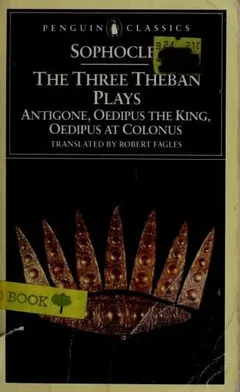
We recommendThe Three Theban Plays, translated by Robert FaglesPenguin Classics, 1984Vivid and speakable, with Bernard Knox's introductions, and it contains all three Theban plays.
Also good
- David Grene. The Chicago series is more literal, and the volume many seminars standardise on.
- Anne Carson. Sparer and stranger, published as Antigonick's companion; good for a second reading, not a first.
These links go straight to Amazon and Bookshop.org and earn this site nothing today. Prices are the same either way. How this works.
Thebes is dying of a plague, and Apollo's oracle says it will lift only when the killer of the old king Laius is found and driven out. Oedipus, who saved the city from the Sphinx and was given its widowed queen Jocasta in marriage, swears a public oath to hunt the man down. Over the course of a single day, and against the warnings of the prophet Tiresias and then of Jocasta herself, he assembles the evidence and discovers that he is the killer, that Laius was his father, and that Jocasta is his mother. She hangs herself. He blinds himself with her brooches and begs Creon to send him out of the city he has saved twice.
Why it's on the list
Aristotle built his account of tragedy in the Poetics largely out of this play, so the vocabulary that Western criticism uses for plot, recognition, reversal and the tragic error all traces back to it. It is also the most efficient plot ever constructed: every scene tightens, and every piece of information Oedipus gathers in order to save his city turns out to destroy him. Programs assign it because it poses a question no later account of responsibility has settled. Oedipus did not know what he was doing, and he did it anyway, and the play refuses to let either fact cancel the other. Freud took the name for his central hypothesis, which has given the play a second and quite separate life in psychology and in ordinary speech.
Key themes
- Fate and freedom
- The oracle predicts but never compels. Every step Oedipus takes toward the truth is one he chooses, including the choices he made to escape the prophecy.
- Knowledge and truth
- Sophocles makes sight and blindness carry the argument. Tiresias sees nothing and knows everything; Oedipus solves riddles and cannot read his own scars.
- Power and authority
- Oedipus rules because he was clever, not because he was born to it, and his competence is exactly what dooms him.
- Family and inheritance
- The play's horror is structural rather than psychological: the same people occupy two incompatible roles, and the language keeps colliding with itself.
- Guilt and redemption
- Oedipus punishes himself for acts he committed without intent, and the play neither endorses nor overturns the verdict.
Overview
Oedipus the King runs about fifteen hundred lines and can be read in an hour and a half. It was staged in Athens around 429 BCE, probably not long after a real plague had killed a quarter of the city’s population, and the play opens on a city full of the dying.
Its structure is the reason it is studied. Everything happens in one place, in front of the palace, in something close to the time it takes to perform. Nothing violent is shown. The killings and the blinding happen offstage and are reported. What is shown instead is investigation: a sequence of interviews in which a competent man questions witnesses, follows the evidence, and arrives at a conclusion. The play is closer in mechanism to a detective story than to anything else in ancient drama, with the difference that the detective is the criminal and does not know it.
The audience knew the myth. That is not a flaw in the design but its engine. Every line Oedipus speaks in confidence has a second meaning available to the spectators and not to him, and Sophocles exploits this relentlessly. When Oedipus swears to expel the murderer, when he pities Laius as a man who died childless, when he calls himself a child of fortune, the words do work he cannot hear. Critics call this tragic irony and this is the play that defines it.
What happens
A delegation of suppliants asks Oedipus to save Thebes from the plague. He has already sent Creon to Delphi, and Creon returns with the oracle: the pollution is the unpunished murder of Laius. Oedipus takes charge, curses the killer, and sends for the blind prophet Tiresias.
Tiresias refuses to speak. Oedipus, insulted, accuses him of conspiring with Creon to take the throne, and the accusation stings the prophet into declaring that Oedipus himself is the polluted man. Oedipus dismisses this as a plot and quarrels bitterly with Creon until Jocasta intervenes.
Then comes the play’s turn. Trying to calm him, Jocasta explains that prophecy is unreliable: Laius was told his son would kill him, yet Laius was killed by robbers at a place where three roads meet. The detail she offers as reassurance is the one that frightens Oedipus, because he killed a man at such a crossroads. He sends for the sole surviving witness.
Before the witness arrives, a messenger comes from Corinth to report the death of Polybus, whom Oedipus believes to be his father, and offers what he takes to be good news: Oedipus was not Polybus’ son at all but a foundling, handed over as an infant with his ankles pinned. Jocasta understands first, begs Oedipus to stop asking, and goes inside. He presses on. The herdsman confirms that the baby came from Laius’ house and that Jocasta gave him the child to expose.
The rest is aftermath. A servant reports Jocasta’s suicide and Oedipus driving her brooch pins into his eyes. He comes out blinded, asks for exile, and is refused an immediate answer by Creon, who will consult the god. His last request is to touch his daughters. The chorus closes with a warning about calling any living person fortunate.
How to read it
Give it a single evening, and speak the lines out where nobody can hear you. The play runs on momentum and on the pressure of talk under interrogation, and parcelling it out over a week dissipates both.
Track who knows what, and when. Make a note at each entrance of what that character knows that Oedipus does not, and you will see the machine working. Jocasta knows before he does, by a good stretch, and her silence in the last scene she plays is the most frightening thing in the text.
Do not import Freud on a first reading. There is no desire for the mother anywhere in the play; Oedipus married a stranger who turned out to be his mother, which is a different proposition entirely. Save that discussion for after you have read what Sophocles wrote.
The second thing to resist is the standard classroom claim that Oedipus is destroyed by pride. He is proud, quick-tempered and unfair to Tiresias and Creon. But he is destroyed by doing his job well, and every accusation he makes is a reasonable inference from what he has been told. If the play were about a character flaw it would be smaller than it is.
Watch the chorus. Their odes are not filler. They move from confidence in Oedipus, through anxiety about oracles and divine law, to bewilderment, and they show you what a decent citizen can and cannot see while it happens.
Fagles for speed and force, Grene for closeness to the Greek. Read the Fagles if you have one evening; read both if you have a seminar.
Questions it raises
- Is Oedipus guilty? He acted without knowledge, and he blinds himself anyway. What standard is he holding himself to?
- The oracle is accurate but never coercive. Does the play believe in fate, or only in a god who knows more than we do?
- Why does Sophocles have Oedipus blind himself rather than die?
- Jocasta works out the truth before her husband does and says nothing. What is the play doing with her silence?
- Oedipus is a good ruler and a good investigator. Does the play suggest that intelligence itself is dangerous?
- Nothing violent is shown onstage. What does the play gain by making us hear rather than see?
Highlights
Count no man happy till he dies, free of pain at last.
A commonplace of Greek thought, given to the chorus after the worst has happened.
Tiresias tells Oedipus that his wisdom is dreadful when it brings its possessor no profit, and refuses at first to say what he knows.
Paraphrase.
Jocasta dismisses prophecy by telling Oedipus that nobody possesses the art of divination, and that chance governs everything.
Paraphrase.
Oedipus, learning the truth from the herdsman, cries out that everything has come clear, and asks for the light of day to be taken from him.
Paraphrase.