Civil Disobedience
Assigned by 1 of the 9 reading lists
An essay based on a lecture Thoreau gave after spending a night in the Concord jail in 1846 for refusing to pay a poll tax that supported slavery and the Mexican War. He argues that the best government is the one that governs least, that a person's first obligation is to do what he thinks right rather than what the majority decides, and that when a government commits injustice a citizen should withdraw his support from it, even at the cost of prison. Published as Resistance to Civil Government in 1849, it was retitled after his death and later influenced Gandhi and Martin Luther King.
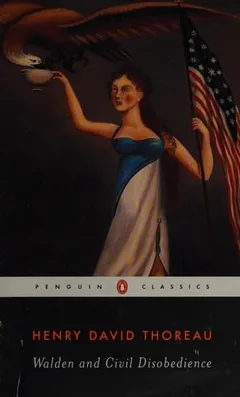
We recommendWalden and Civil DisobediencePenguin Classics, 1983Both texts in one cheap volume with Michael Meyer's introduction.
As an Amazon Associate, The Great Books earns from qualifying purchases. Bookshop.org links also support this site. How this works.
- Written
- 1849
- Form
- Essay
- Language
- English
- Length
- Short · 25 ppunder 120 pages
- Difficulty
- Moderate2 of 5 for a first-year reader
Why it's on the list
Arguing that a person's first obligation is to do what he thinks right rather than what the majority decides places conscience above the vote, and so asks whether democracy itself can make an unjust law binding. Insisting that when a government commits injustice a citizen should withdraw his support from it, even at the cost of prison, turns a private refusal to pay a tax into a general theory of resistance, in which the jail becomes the one place an honest man can stand under an unjust state. Grounding the whole argument in a single night in the Concord jail keeps it tied to an act rather than a doctrine, and it was as an act that Gandhi and Martin Luther King later took it up. Opening with the claim that the best government is the one that governs least gave later readers on the right as well as the left a text to claim, and the essay has been enlisted by movements that would not recognise one another.
Key themes
- Liberty and rights
- Opening with the claim that the best government is the one that governs least, and looking toward one that governs not at all, made the essay a text for later movements of very different kinds.
- Justice
- Insisting that when a government commits injustice a citizen should withdraw his support from it turns a private refusal to pay a tax into a general theory of resistance.
- Power and authority
- Placing conscience above the vote asks whether a democratic majority can make an unjust law binding on the individual who sees its injustice.
- Virtue and character
- Under an unjust government, Thoreau says, the true place for a just man is prison, the jail becoming the one honest position available.
- Society and the state
- Grounding the argument in a single night in the Concord jail keeps it tied to an act rather than a doctrine, which is how Gandhi and King later took it up.
Which edition to read
Our pick
Walden and Civil Disobedience
Penguin Classics, 1983
Both texts in one cheap volume with Michael Meyer's introduction.
Amazon: the Penguin Classics edition, opens in a new tabBookshop.org: the Penguin Classics edition, opens in a new tab
Overview
A twenty-five page essay, published in 1849, based on a lecture Thoreau gave after spending a night in the Concord jail in 1846 for refusing to pay a poll tax that supported slavery and the Mexican War. He argues that the best government is the one that governs least, that a person’s first obligation is to do what he thinks right rather than what the majority decides, and that when a government commits injustice a citizen should withdraw his support from it, even at the cost of prison.
Published as Resistance to Civil Government in 1849, it was retitled after his death and later influenced Gandhi and Martin Luther King.
What happens
The government that governs least. Thoreau opens by accepting the motto that the best government governs least, and pressing it further: when men are ready for it, the best government will govern not at all. Government is at most an expedient, and the standing army and the Mexican War show how it is abused.
Conscience against the majority. He asks whether a citizen should resign his conscience to the legislator, and answers that we should be men first and subjects afterward. A majority rules not because it is right but because it is strongest, and the mass of men serve the state as machines, with their bodies.
Slavery and the war. Thoreau turns to Massachusetts, which he says cannot be honestly called a free state while it tolerates slavery and supports the war, and rejects the counsel to wait for the majority to be persuaded: if the law requires you to be the agent of injustice to another, break the law.
Withdrawing support. The practical remedy is to withdraw allegiance, in person and property, from the state. He describes his own refusal to pay the poll tax for six years, and argues that if a thousand men refused this year, the machine would stop.
The night in jail. Thoreau recounts his night in the Concord jail, the thick walls that could not lock up his thoughts, his cellmate, and his release when someone paid the tax without his consent, after which he went huckleberrying with a party of boys.
The state’s limits. He closes by granting that the state does some good and that he will obey it where he can, but insists that a state which cannot recognise the individual as a higher and independent power is not yet a truly free and enlightened one.
How to read it
Read the essay as the record of an act rather than a doctrine, the night in the Concord jail standing behind every general claim, and ask how much of the argument the act itself carries.
Pay close attention to the claim that a person’s first obligation is to do what he thinks right rather than what the majority decides, and to what it implies about whether a democratic vote can make an unjust law binding.
Notice how the insistence that a just man’s true place under an unjust government is prison turns refusal into a position rather than a withdrawal, and how the essay makes the jail a place of freedom.
Consider how the opening claim about the government that governs least has let the essay be claimed by movements of very different kinds, and decide whether Thoreau’s individualism belongs to any of them.
Read this essay alongside Plato’s Crito to set Thoreau’s refusal against Socrates’s argument that a citizen who has accepted the laws’ benefits must accept their sentence.
Questions it raises
- Can conscience really be placed above the vote without dissolving the possibility of common life, or is Thoreau describing a limit that any democracy needs?
- Is the withdrawal of a single citizen’s support an effective act against injustice, or does its power depend entirely on the thousand others Thoreau imagines joining him?
- Why does the jail become, in Thoreau’s telling, a place of freedom, and what does the huckleberrying afterward add to or subtract from the seriousness of his stand?
- How did Gandhi and King transform an essay about one man’s refusal into a strategy for mass movements, and what did they have to change?
- Does the essay’s opening vision of a government that governs not at all sit easily with the moral demands it makes, or does Thoreau want both a minimal state and a righteous one?
- What did Thoreau think a citizen owes the state that does some good, and where exactly does his obligation to it end?
Highlights
Thoreau argues that the best government is the one that governs least, and that a person's first obligation is to do what he thinks right rather than what the majority decides.
Paraphrase of the essay's two founding claims, minimal government and the priority of conscience over majority rule.
When a government commits injustice a citizen should withdraw his support from it, even at the cost of prison, since under such a government the true place for a just man is a jail.
Paraphrase of the essay's central practical conclusion, refusal as the honest response to injustice.
The essay grew from a lecture Thoreau gave after spending a night in the Concord jail in 1846 for refusing to pay a poll tax that supported slavery and the Mexican War, and was retitled after his death.
Paraphrase of the essay's occasion, a single act of refusal from which the general argument grew.