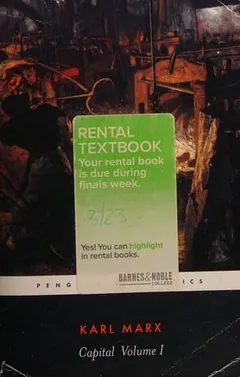
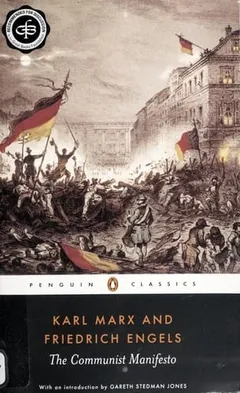
Economic and Philosophic Manuscripts of 1844
by Karl Marx · Ökonomisch-philosophische Manuskripte aus dem Jahre 1844
Assigned by 3 of the 9 reading lists
Unfinished notebooks written in Paris when Marx was twenty-six, unknown until their publication in 1932. Starting from the categories of the political economists, wages, profit and rent, Marx argues that under private property the worker is estranged from the product of his labour, from the activity of working, from his own human nature as a species being, and from other people. Later sections treat private property and communism as the overcoming of this estrangement, discuss money, and criticise Hegel's dialectic while adopting its idea of self-creation through labour.
We recommendThe Marx-Engels Reader, translated by Martin MilliganW. W. Norton, 1978Robert Tucker's anthology, which contains the key manuscripts and is the edition most programs assign.
Also goodcompare
- Martin Milligan. The manuscripts on their own and cheaply, with Engels' essay on political economy that set Marx reading.
- Rodney Livingstone and Gregor Benton. Prints the manuscripts with the other early texts, including On the Jewish Question and the Theses on Feuerbach, which is the right company for them.
As an Amazon Associate, The Great Books earns from qualifying purchases. Bookshop.org links also support this site. How this works.
- Written
- 1844, published 1932
- Form
- Political theory
- Language
- German
- Length
- Short · 110 ppunder 120 pages
- Difficulty
- Difficult4 of 5 for a first-year reader
Why it's on the list
These notebooks were written by a twenty-six-year-old in Paris, abandoned unfinished, and not published until 1932, by which time Marxism had been a state ideology for fifteen years and looked nothing like them. Their appearance split the field. Here is a Marx whose subject is not the falling rate of profit but what work does to the person doing it: the worker is estranged from the thing he makes, from the act of making, from his own nature as a being who produces, and from other people. The concept of alienation gave the twentieth century a vocabulary for saying what is wrong with a job that pays adequately, and it is the basis of the humanist Marx that Sartre, Marcuse and the New Left reached for and that Althusser argued was superseded by the mature economic work.
Key themes
- Money and class
- Political economy is accepted on its own terms and then turned against itself: it treats labour as a cost and never asks what the worker is, and its own categories show wages falling as production rises.
- The self and identity
- Alienated labour has four aspects: from the product, which confronts you as an alien thing; from the activity, which is not yours; from species-being, the human capacity to produce freely; and from other people.
- The good life
- Marx's positive claim is that free conscious activity is what human beings are for, and that under these conditions people feel human only in eating, drinking and procreating, and animal in what should be most human.
- History and progress
- Hegel is credited with grasping labour as the process by which humanity makes itself, and faulted for treating the objects of labour as thought rather than as things, so that the alienation is resolved in philosophy and not in life.
Which translation to read
For Economic and Philosophic Manuscripts of 1844 the translation is most of the decision. Our pick is the Martin Milligan translation; the others are good for different reasons.
Our pick
The Marx-Engels Reader, translated by Martin Milligan
W. W. Norton, 1978
Robert Tucker's anthology, which contains the key manuscripts and is the edition most programs assign.
Amazon: the Martin Milligan translation, opens in a new tabBookshop.org: the Martin Milligan translation, opens in a new tab
Also good
Economic and Philosophic Manuscripts of 1844, translated by Martin Milligan
Prometheus Books, 1988
The manuscripts on their own and cheaply, with Engels' essay on political economy that set Marx reading.
Amazon: the Martin Milligan translation, opens in a new tabBookshop.org: the Martin Milligan translation, opens in a new tab
Also good
Early Writings, translated by Rodney Livingstone and Gregor Benton
Penguin Classics, 1992
Prints the manuscripts with the other early texts, including On the Jewish Question and the Theses on Feuerbach, which is the right company for them.
Amazon: the Rodney Livingstone and Gregor Benton translation, opens in a new tabBookshop.org: the Rodney Livingstone and Gregor Benton translation, opens in a new tab
Overview
These are notebooks, not a book. Marx wrote them in Paris in the spring and summer of 1844, aged twenty-six, newly married, working in the reading rooms while editing a short-lived journal, and he stopped partway and moved on. They sat unpublished for eighty-eight years and appeared in Moscow in 1932.
The physical state matters. The manuscripts are incomplete, pages are missing, some sheets are ruled into three columns with headings for wages, profit and rent, and the columns break down as Marx’s own argument takes over. One section is a set of extracts from the economists with his comments attached. There is no finished structure, and editors have had to impose the order in which they are printed.
They are best read as a young man teaching himself political economy in public. Marx reads Adam Smith, Ricardo, Say and Mill, accepts their descriptions of how the system works, and then asks a question they do not ask: what is this doing to the people inside it? The tools he uses for that question come from Hegel, by way of Feuerbach, who had argued that God is a projection of human qualities onto an imaginary being who then rules over us. Marx takes the shape of that argument and applies it to labour and to money.
About a hundred and ten pages, and uneven: some of it is brilliant, some is note-taking, and the section on Hegel at the end is very hard.
The argument
The first manuscript: wages, profit, rent, and then estranged labour. Marx begins inside political economy. Wages are determined by a struggle in which the owner can hold out longer. Competition concentrates capital. When society is declining the worker suffers most; when it is advancing he suffers differently, since his work grows more one-sided and more intense. Political economy, Marx says, describes all this and explains none of it, because it treats private property as a fact rather than as something to be accounted for, and it never asks what the worker is.
Then the section the manuscripts are read for. Marx starts from what he calls a present-day economic fact: the worker becomes poorer the more wealth he produces, and the more value he creates in things the less he is worth himself. The object he makes stands over against him as something alien and hostile.
He then analyses this into four aspects.
Alienation from the product. What you make is not yours, it belongs to someone else, and the more you produce the more powerful the world of objects becomes against you. This is the same structure Feuerbach found in religion: the more a man puts into God the less he keeps for himself.
Alienation from the activity. The work itself is not yours. It is not voluntary, it satisfies no need of your own but only the need to keep a job, and therefore you are not at home in it. Marx’s formulation is that the worker feels himself only when he is not working, and outside himself when he is.
Alienation from species-being. Marx’s term for what he takes to be distinctively human: that we produce consciously and freely, not only under the compulsion of immediate need, and can therefore make according to any measure, including beauty. Wage labour reduces that capacity to a means of staying alive, so the highest human activity becomes merely animal.
Alienation from other people. If I am estranged from my own activity and my own nature, I am estranged from everyone else too, and other people become competitors or employers rather than fellow producers.
He then makes the move that turns the analysis into a theory: private property is usually offered as the cause of alienated labour, and in fact it is its consequence, the result of the relation, which means the arrow of explanation runs the other way.
The second manuscript. Mostly lost. What survives treats the relation of private property to labour and capital as the two poles of one contradiction.
The third manuscript. Several distinct pieces. A section on private property and communism, where Marx distinguishes his position from what he calls crude communism, which simply universalises ownership, levels everything to a minimum and would abolish talent; against this he describes communism as the resolution of the conflict between man and nature and between man and man, and is careful to say that it is a movement rather than a state of affairs to be installed.
A short and striking section on the power of money, built around quotations from Shakespeare’s Timon of Athens and Goethe’s Faust, arguing that money is the alienated capacity of mankind: it buys what you are not, makes the ugly beautiful and the coward brave, and inverts every quality into its opposite.
And finally a critique of Hegel’s dialectic. Marx credits Hegel with the greatest insight available, that labour is the process through which humanity produces itself, and faults him for taking the objects of labour to be thought rather than things, so that alienation is overcome by understanding it rather than by changing anything.
How to read it
Read the section on estranged labour in the first manuscript, the section on the power of money, and the section on private property and communism. That is perhaps forty pages and it is what the notebooks are for.
Leave the Hegel critique until last, and do not be discouraged by it. It assumes the Phenomenology and is the hardest thing here.
Read some Feuerbach, or at least know the argument: that theology is anthropology, and that God is the human essence projected outward and then worshipped. Marx’s whole account of alienation is that argument redirected at economic life.
Keep the date in view. This is the young Marx. There is no theory of surplus value here, no historical materialism worked out, no class analysis of the kind in the Manifesto four years later. The vocabulary is still Hegelian, and the central category, species-being, disappears from his later work.
Know what the argument about them is. When the manuscripts appeared in 1932 they were taken by Western readers as evidence of a humanist Marx concerned with freedom and self-realisation rather than with economic laws. Althusser replied that there is an epistemological break between these notebooks and Capital, and that the early work is pre-scientific and should not be used to soften the later. That dispute is still going and reading the manuscripts alongside the first part of Capital is the way to have an opinion about it.
Questions it raises
- Is alienation a claim about capitalism specifically, or about any division of labour?
- Species-being assumes a human essence that wage labour violates. Can that be defended without a theory of what people are for?
- Marx says private property is the consequence of alienated labour rather than its cause. What difference does that make to what you would do about it?
- The worker feels at home only when not working. Is that a description of 1844, or of work as such?
- If money makes every quality into its opposite, what exactly is the objection: that it lies about value, or that it creates the only value there is?
- Is there a break between these notebooks and Capital, or a development? What would count as evidence either way?
Highlights
The worker becomes poorer the more wealth he produces. The devaluation of the world of men is in direct proportion to the increasing value of the world of things.
Paraphrase of the opening of the section on alienated labour, which begins from facts Marx says political economy admits and cannot explain.
The worker therefore feels himself only when he is not working, and when he is working he does not feel himself. He is at home when he is not working, and when he is working he is not at home.
Money is the universal agent of separation and of union, the truly creative power, the visible divinity.
Paraphrase of the section in which Marx argues that money makes contradictions embrace, buys what a person is not, and turns every quality into its opposite.
Communism is the positive supersession of private property as human self-estrangement, and therefore the real appropriation of human essence by and for man.
Paraphrase. Marx distinguishes this from what he calls crude communism, which merely universalises private property and levels everything downward.