On Liberty
Assigned by 5 of the 9 reading lists
Mill argues that the only purpose for which power may rightly be used against an adult against his will is to prevent harm to others. He defends complete freedom of thought and discussion on the grounds that a silenced opinion may be true, may be partly true, or may keep a true opinion from hardening into dead dogma. He then defends individuality and experiments in living against the pressure of custom and public opinion, and works out where the principle stops: no liberty to harm, and no liberty for children.
We recommendOn LibertyHackett, 1978Elizabeth Rapaport's edition is cheap, well annotated and the one most courses assign.
Also goodcompare
- Cambridge. Prints it with The Subjection of Women and Chapters on Socialism, which show what Mill did with the principle.
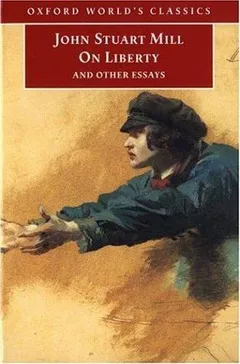
- Oxford World's Classics. Pairs it with Utilitarianism, which is the moral theory the argument is standing on.
As an Amazon Associate, The Great Books earns from qualifying purchases. Bookshop.org links also support this site. How this works.
- Written
- 1859
- Form
- Political theory
- Language
- English
- Length
- Short · 120 ppunder 120 pages
- Difficulty
- Moderate2 of 5 for a first-year reader
Why it's on the list
Every modern argument about free speech runs through this essay, usually without knowing it. The harm principle, that the only warrant for coercing an adult is to prevent harm to others, is the default liberal answer to where the state stops, and Mill's defence of open discussion is still the strongest one anybody has written: not that speech is harmless, but that a silenced opinion may be true, and that even a false one keeps a true opinion from hardening into a dead formula nobody can explain. Programs assign it because it is the clearest short statement of liberalism's core commitment and because it is genuinely vulnerable. Mill excludes children, excludes those he calls barbarians, and never quite defines harm, and the arguments those gaps started are the arguments now being had about platforms, pronouns and public health.
Key themes
- Liberty and rights
- Mill's liberty is negative and specific: the absence of coercion over conduct that concerns only yourself. He is not defending a right to do anything, but drawing a line the majority may not cross.
- Society and the state
- The danger he names is not the tyrant but the public. Social pressure, he argues, penetrates further than law and leaves fewer means of escape.
- Knowledge and truth
- The case for free discussion is epistemic rather than sentimental. We silence opinions on the assumption of our own infallibility, and the record of what has been confidently silenced should cure anybody of that.
- Education
- Mill wants character formed by choosing, not by conforming. A person who lets the world choose their plan of life needs no faculty but apelike imitation.
Which edition to read
For On Liberty the edition is most of the decision. Our pick is the Hackett edition; the others are good for different reasons.
Our pick
On Liberty
Hackett, 1978
Elizabeth Rapaport's edition is cheap, well annotated and the one most courses assign.
Amazon: the Hackett edition, opens in a new tabBookshop.org: the Hackett edition, opens in a new tab
Also good
On Liberty and Other Writings, edited by Stefan Collini
Cambridge, 1989
Prints it with The Subjection of Women and Chapters on Socialism, which show what Mill did with the principle.
Amazon: the Stefan Collini edition, opens in a new tabBookshop.org: the Stefan Collini edition, opens in a new tab
Also good
On Liberty, Utilitarianism and Other Essays
Oxford World's Classics, 2015
Pairs it with Utilitarianism, which is the moral theory the argument is standing on.
Amazon: the Oxford World's Classics edition, opens in a new tabBookshop.org: the Oxford World's Classics edition, opens in a new tab
Overview
A hundred and twenty pages in five chapters, published in 1859, the year of the Origin of Species. Mill wrote it with his wife Harriet Taylor Mill, who died before it appeared and whom he credits in a dedication as its joint author; how much of it is hers is unsettled and worth knowing about as you read.
The question is not the old one about the limits of the king’s power. Britain in 1859 was already representative. Mill’s worry is what happens when the people rule: a majority can oppress as thoroughly as a monarch, and because it works through opinion and custom rather than law, there is nowhere to appeal. He is looking for a principle that marks off a zone of life where neither the state nor the neighbours may interfere.
The book is argued rather than asserted, and it is short, but it is dense. Chapter 2 alone is about forty pages and contains the part everyone quotes.
The argument
Chapter 1 states the principle. Over himself, over his own body and mind, the individual is sovereign. Power may be used against an adult only to prevent harm to others, never for his own good. Mill is explicit that this rests on utility, not on natural rights: utility in the largest sense, grounded on the permanent interests of man as a progressive being. He excludes children, and he excludes societies he considers backward, where he thinks despotism is legitimate if it improves them. That exclusion is not a footnote; it is on the page, and it sits uncomfortably with everything else.
Chapter 2 defends liberty of thought and discussion, and it is the strongest thing in the book. The argument is a dilemma. A silenced opinion is either true, false, or partly true. If true, we lose the chance to exchange error for truth. If false, we lose something almost as valuable, the clearer perception of truth produced by its collision with error. If partly true, which is the usual case, we lose the part we were missing. To silence is to assume infallibility, and the history of confident suppression, Socrates, Jesus, Marcus Aurelius persecuting Christians in good conscience, should end that assumption. Mill adds a further claim that is easy to miss: a truth nobody argues with becomes a dead dogma, held as a formula, doing nothing.
Chapter 3 defends individuality. Having secured the right to think, Mill wants the right to live differently: experiments in living, so that new ways of being human can be tried and judged. He fears the opposite, a society where everyone is respectable and nobody has any character, and he thinks England is well on the way.
Chapter 4 draws the line. Where does self-regarding conduct end? Mill distinguishes harm from offence and from distaste, and allows society to warn, avoid and disapprove, but not to coerce. A man may ruin himself with drink; if he neglects a duty to his family, society may act, but for the neglected duty, not the drinking.
Chapter 5 applies it to cases: free trade, poisons, gambling houses, the sale of alcohol, marriage contracts, and compulsory education. Mill supports requiring parents to educate their children while opposing state-run schools, on the ground that a state which shapes minds is a state which owns them.
How to read it
Read chapters 1 and 2 closely and slowly. If time is short, read chapter 2 twice and skim chapters 4 and 5. Chapter 2 is where the reputation lives and where the argument is most complete.
Track the word harm. Mill never defines it, and almost every modern dispute about the principle is a dispute about where harm starts: does offence count, does economic damage, does a risk imposed on others, does the harm done to a society by the spread of an idea. Mark the places where his own examples strain, and they do strain, particularly in chapter 5.
Read the exclusions honestly rather than around them. The passage about barbarians is a real part of a book written by a senior official of the East India Company. The question is not whether it is embarrassing, it is whether the argument of chapters 1 to 3 gives Mill any right to it, and the interesting answer is that it does not.
Notice that Mill is a utilitarian defending liberty. He cannot say you have a right to speak that outweighs consequences; he has to argue that freedom produces better consequences than control. That is a harder position than it looks, and it is why chapter 2 spends so long on the practical value of error.
A common misreading is that Mill defends speech because speech cannot hurt. He says the opposite: an opinion that corn dealers starve the poor may be published freely, and may not be shouted to a mob at a corn dealer’s door.
Questions it raises
- What counts as harm? If a definition is broad enough to cover serious social damage, does the principle still restrain anybody?
- Mill’s strongest argument for free speech is that it helps us find truth. What follows where speech spreads faster than anyone can check it?
- Is there genuinely a class of purely self-regarding actions, or is every choice entangled with others?
- Mill fears the tyranny of opinion more than the tyranny of law. Was he right, and does that make social disapproval a form of coercion or the ordinary working of a free society?
- The exclusion of “barbarians” contradicts the book’s own reasoning. Can the argument be repaired by deleting it, or does it reveal something about who the principle was written for?
- If a true opinion held without argument becomes dead dogma, what should a society do about truths it is no longer willing to debate?
Highlights
The only purpose for which power can be rightfully exercised over any member of a civilised community, against his will, is to prevent harm to others. His own good, either physical or moral, is not a sufficient warrant.
If all mankind minus one were of one opinion, and only one person were of the contrary opinion, mankind would be no more justified in silencing that one person than he, if he had the power, would be justified in silencing mankind.
He who knows only his own side of the case knows little of that.
He who lets the world, or his own portion of it, choose his plan of life for him has no need of any other faculty than the ape-like one of imitation.