In Search of Lost Time
by Marcel Proust · À la recherche du temps perdu
Assigned by 1 of the 9 reading lists
A novel in seven volumes, three of them published after Proust's death, narrated by a man looking back on his life from childhood in Combray to old age in Paris after the First World War. Around him move the Swanns, the Guermantes, the Verdurins, the Baron de Charlus and Albertine, whom the narrator imprisons in his flat and loses. Its subjects are jealousy, snobbery, homosexuality, the Dreyfus affair, the decay of the aristocracy and the war, and above all time. In the last volume a series of involuntary memories reveals to the narrator the book he must write, which is the one just read.
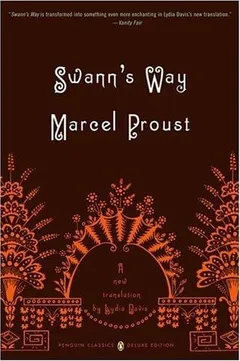
We recommendIn Search of Lost Time, translated by C. K. Scott Moncrieff, Terence Kilmartin and D. J. EnrightModern Library, 2003The revised Scott Moncrieff in six volumes, the text most readers of the whole novel in English use.
As an Amazon Associate, The Great Books earns from qualifying purchases. Bookshop.org links also support this site. How this works.
- Written
- 1913-1927
- Form
- Novel
- Language
- French
- Length
- Epic · 4200 ppover 700 pages
- Difficulty
- Formidable5 of 5 for a first-year reader
C. K. Scott Moncrieff, Terence Kilmartin and D. J. Enright translation
Buy on Amazon: In Search of Lost Time, opens in a new tabBookshop.org: In Search of Lost Time, opens in a new tab
Why it's on the list
The narrator imprisoning Albertine in his flat and eventually losing her stages jealous possessive love as a genuinely self-defeating project, attempting to control and contain another person's freedom in ways that ultimately guarantee her escape rather than secure any lasting devotion. The novel's considerable subjects, jealousy, snobbery, homosexuality, the Dreyfus affair, the aristocracy's decay and the war, unfold across a canvas broad enough to trace how French society itself transformed across the same decades charting the narrator's own personal development from childhood through age. The final volume's series of involuntary memories revealing to the narrator the book he must write, which is the one just read, closes the entire seven-volume structure with a genuinely audacious circularity, the novel's own composition becoming its concluding subject and justification. Three volumes published only after Proust's own death mean readers encounter his final vision without the additional revision he might otherwise have applied, a monumental work completed under the shadow of the author's own approaching mortality that its final volumes explicitly meditate upon.
Key themes
- The self and identity
- The final volume's series of involuntary memories revealing to the narrator the book he must write, which is the one just read, closes the entire seven-volume structure with genuine circularity, the novel's own composition becoming its concluding subject.
- Love and desire
- The narrator imprisoning Albertine in his flat and eventually losing her stages jealous possessive love as a genuinely self-defeating project, attempting to control another person's freedom in ways that ultimately guarantee her escape rather than lasting devotion.
- Money and class
- The novel's considerable subjects, snobbery and the aristocracy's decay among them, unfold across a canvas broad enough to trace how French society itself transformed across the same decades charting the narrator's own personal development.
- History and progress
- The Dreyfus affair and the war run throughout the novel's later volumes, connecting the narrator's intensely personal memory and development directly to the larger historical transformations reshaping French society across his own lifetime.
Which translation to read
Our pick
In Search of Lost Time, translated by C. K. Scott Moncrieff, Terence Kilmartin and D. J. Enright
Modern Library, 2003
The revised Scott Moncrieff in six volumes, the text most readers of the whole novel in English use.
Amazon: the C. K. Scott Moncrieff, Terence Kilmartin and D. J. Enright translation, opens in a new tabBookshop.org: the C. K. Scott Moncrieff, Terence Kilmartin and D. J. Enright translation, opens in a new tab
Overview
About four thousand two hundred pages, Marcel Proust’s novel in seven volumes, published between 1913 and 1927, three of them after Proust’s own death. It is narrated by a man looking back on his life from childhood in Combray to old age in Paris after the First World War.
Around him move the Swanns, the Guermantes, the Verdurins, the Baron de Charlus and Albertine, whom the narrator imprisons in his flat and loses. Its subjects are jealousy, snobbery, homosexuality, the Dreyfus affair, the decay of the aristocracy and the war, and above all time. In the last volume a series of involuntary memories reveals to the narrator the book he must write, which is the one just read.
What happens
Childhood in Combray. The narrator recalls his childhood in Combray, establishing the novel’s characteristic method of detailed, sensory memory that will structure the entire seven-volume retrospective narrative to come.
The Swanns and Odette. Charles Swann’s own earlier love for Odette, narrated within the novel’s opening volumes, provides an extended meditation on jealousy and obsession that anticipates the narrator’s own later relationship with Albertine.
Entering Parisian society. The narrator gradually enters Parisian aristocratic and artistic society, encountering the Guermantes, the Verdurins and the Baron de Charlus, a considerable cast whose intersecting lives structure the novel’s extended social world.
The relationship with Albertine. The narrator’s relationship with Albertine develops into obsessive jealousy, and he eventually imprisons her within his own flat, an attempt to control her freedom that will ultimately guarantee her escape rather than secure devotion.
The Dreyfus affair and social change. The Dreyfus affair, the aristocracy’s decay, and eventually the war run throughout the novel’s later volumes, connecting the narrator’s intensely personal memory directly to the larger historical transformations of his era.
The revelation of the book to be written. In the final volume, a series of involuntary memories reveals to the narrator the book he must write, which is the one just read, closing the entire structure with the novel’s own composition as its concluding subject.
How to read it
Read the narrator imprisoning Albertine in his flat and eventually losing her as staging jealous possessive love as a genuinely self-defeating project, attempting to control another person’s freedom in ways that ultimately guarantee her escape rather than lasting devotion.
Pay close attention to how the novel’s considerable subjects, jealousy, snobbery, homosexuality, the Dreyfus affair, the aristocracy’s decay and the war, unfold across a canvas broad enough to trace French society’s own transformation across the same decades.
Notice how the final volume’s series of involuntary memories revealing the book the narrator must write, which is the one just read, closes the entire seven-volume structure with genuine circularity, the novel’s own composition becoming its concluding subject and justification.
Consider that three volumes published only after Proust’s own death mean readers encounter his final vision without the additional revision he might otherwise have applied, a monumental work completed under the shadow of mortality its final volumes explicitly meditate upon.
Read this novel alongside Woolf’s own To the Lighthouse to compare two major modernist treatments of memory, time and consciousness, each developing distinctive formal techniques for capturing how the past persists within and shapes present experience.
Questions it raises
- Does the narrator’s imprisonment of Albertine represent a comprehensible, even sympathetic response to genuine jealous anxiety, or does the novel ultimately condemn this possessive control as a fundamental misunderstanding of what love actually requires and makes possible?
- How does the novel’s considerable historical breadth, the Dreyfus affair, the aristocracy’s decay, the war, relate to its intensely personal focus on memory and individual consciousness? Does history function as backdrop, or as equally central subject alongside personal experience?
- What does the final revelation, that the narrator’s true vocation is writing the very book just read, accomplish structurally and philosophically? Does this circular conclusion represent genuine artistic achievement, or does it risk feeling like a convenient narrative trick?
- How should a reader approach a novel whose final volumes were published only after the author’s death, without his own final revision? Does this incomplete authorial control change how definitively readers should treat the novel’s actual concluding vision?
- Given the novel’s considerable length, roughly four thousand pages, what does this scale accomplish that a more compressed treatment of similar themes could not? Does genuine understanding of memory and time require this kind of extended, cumulative reading experience?
- What does this novel’s continued reputation as one of literature’s essential achievements, despite its considerable length and difficulty, suggest about readers’ persistent hunger for sustained, deeply interior exploration of memory, time and consciousness across an entire human life?
Highlights
A novel in seven volumes, three of them published after Proust's death, narrated by a man looking back on his life from childhood in Combray to old age in Paris after the First World War, its subjects jealousy, snobbery, homosexuality and the Dreyfus affair.
Paraphrase of the novel's overall structure and scope, a life recollected across seven published volumes.
Around the narrator move the Swanns, the Guermantes, the Verdurins, the Baron de Charlus and Albertine, whom the narrator imprisons in his flat and loses, a considerable cast of characters whose intersecting lives structure the novel's extended social world.
Paraphrase of the novel's major characters, centering on the narrator's possessive and ultimately failed relationship with Albertine.
In the last volume a series of involuntary memories reveals to the narrator the book he must write, which is the one just read, closing the entire structure with genuine circularity, the novel's own composition becoming its concluding subject and justification.
Paraphrase of the novel's celebrated conclusion, involuntary memory revealing the narrator's true vocation as the novel itself.