The Misanthrope
by Molière · Le Misanthrope
Assigned by 2 of the 9 reading lists
Alceste despises the flattery and small lies that hold Parisian society together and insists on saying exactly what he thinks, which loses him a lawsuit and most of his friends. He is nonetheless in love with Célimène, a young widow whose wit and pleasure in admirers embody everything he condemns. Over a single day of visits, quarrels and intercepted letters he demands that she leave society with him; she refuses, and he walks out alone. The play leaves open whether Alceste is a hero of honesty or a comic fool.
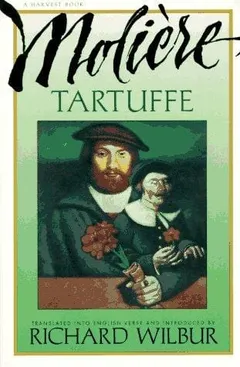
We recommendThe Misanthrope, translated by Richard WilburHarcourt, 1955Wilbur's couplets are the version most anthologies and programs use.
As an Amazon Associate, The Great Books earns from qualifying purchases. Bookshop.org links also support this site. How this works.
- Written
- 1666
- Form
- Comedy
- Language
- French
- Length
- Short · 100 ppunder 120 pages
- Difficulty
- Moderate2 of 5 for a first-year reader
Richard Wilbur translation
Find this edition: The Misanthrope, opens in a new tabBookshop.org: The Misanthrope, opens in a new tab
Why it's on the list
The Misanthrope is the only comedy that has ever seriously divided its audiences about whether it is one. Alceste refuses to flatter, refuses to lie, refuses to tell a bad poet that his sonnet is good, and is destroyed by a society that runs entirely on those small accommodations; he is also vain, self-dramatising, in love with the woman who embodies everything he condemns, and wrong about most particulars. Rousseau attacked Moliere for making an honest man ridiculous and said it was the most dangerous play ever written; two centuries of readers have found Alceste a hero. Moliere played the part himself, with his own wife as Celimene, at a moment when their marriage was in public difficulty, which gives the ending an edge the text alone does not explain. Nothing in comedy has a bleaker last line.
Key themes
- Virtue and character
- Alceste's principle is that speech should mean what it says. The play does not refute it; it shows the principle applied without judgement, to a friend's poem, in a lawsuit, and to a woman, and lets the reader weigh what it costs.
- Language and rhetoric
- The whole society runs on a code in which nothing said in a drawing room is meant literally. Philinte's defence of that code is the most reasonable speech in the play and is also a defence of lying.
- Love and desire
- Alceste loves the one person who cannot give him what he demands. Celimene is twenty, widowed, socially brilliant, and keeps four suitors in play by writing each of them the same letter about the others.
- Society and the state
- The mechanism of ruin is social rather than legal: a lawsuit lost because he would not court the judges, a sonnet criticised too honestly, and a quarrel that reaches the marshals of France.
Which translation to read
Our pick
The Misanthrope, translated by Richard Wilbur
Harcourt, 1955
Wilbur's couplets are the version most anthologies and programs use.
Amazon: the Richard Wilbur translation, opens in a new tabBookshop.org: the Richard Wilbur translation, opens in a new tab
Overview
The Misanthrope is five acts of rhymed alexandrine couplets, about a hundred pages, first performed in June 1666 by Moliere’s own company at the Palais-Royal. He played Alceste. His wife Armande Bejart, twenty years younger than him and the subject of a good deal of talk, played Celimene.
It was not a great success at first. Audiences who had come for the farce of the earlier plays found a comedy with no disguises, no beatings, no servants scheming, hardly any plot, and an ending in which nothing is resolved and the hero walks out. Its reputation grew steadily afterwards and it is now generally reckoned his best work.
Formally it is the purest thing he wrote. One salon, one day, no subplot, twelve characters of whom four matter, and almost all of the action is conversation. The comedy comes from watching an inflexible man meet a series of situations that require flexibility.
The verse is the difficulty in English. Richard Wilbur’s rhymed translation is the standard and is a considerable achievement; prose versions lose the tension between the formality of the couplets and the awkwardness of what is being said in them.
What happens
Act I. Alceste is furious. He has just watched his friend Philinte embrace a man whose name he could not afterwards remember, and he wants to know how anyone can behave like that. Philinte’s answer is the reasonable one: society requires these forms, everyone understands them, and it would be madness to tell every acquaintance exactly what you think of him.
Alceste will not have it. He wants speech to mean what it says, he declares he will not flatter, and he mentions the lawsuit he is currently losing and refuses to lift a finger about, since to solicit a judge would be to admit that justice depends on influence.
Then the trap. Oronte, a nobleman, arrives with a sonnet he has written and asks for Alceste’s opinion. Alceste tries three times to avoid answering, says that a gentleman of his acquaintance was told that the itch to write should be resisted, and is pressed until he says it plainly: the sonnet is worthless, and the poem Oronte should lock in a drawer. Oronte leaves civilly and takes the matter to the marshals of France, which is how the play’s machinery starts.
Act II. The other difficulty. Alceste is in love with Celimene, a twenty-year-old widow whose house is the centre of a circle of suitors and who is the wittiest character in the play. He demands that she choose him and dismiss the others; she points out that she cannot throw people out of her drawing room to satisfy his jealousy.
Then the salon fills up and Celimene performs. Asked about a series of absent acquaintances, she produces a portrait of each, precise and devastating, while the marquesses laugh. Alceste explodes at the company for encouraging her, and she observes that he is only angry because he agrees with everything she has said.
Act III. Arsinoe arrives, an older woman of strict reputation who is not invited anywhere, and she and Celimene conduct the most vicious scene in French comedy entirely in the language of friendly concern. Arsinoe reports what people are saying about Celimene’s conduct; Celimene reports what people are saying about Arsinoe’s prudery and her failure to attract anyone. Arsinoe then tries for Alceste herself and, failing, offers him proof of Celimene’s infidelity.
Act IV. Eliante, Celimene’s cousin, gives the one speech of unmixed sense in the play, on how a lover sees the beloved’s faults as virtues. Alceste arrives with the letter Arsinoe gave him, and the confrontation is not what he expects: Celimene refuses to explain, tells him to believe what he likes, and he collapses into asking her to pretend to be faithful, which he admits is exactly what he has spent the play condemning.
Act V. The lawsuit is lost. Alceste is also facing action over the sonnet. He announces he will leave society entirely.
Then the letters. Oronte and one of the marquesses each produce a letter from Celimene, and reading them aloud they discover that she has written the same things to each of them, mocking the others in identical terms. Everyone leaves.
Alceste, alone with her, makes a final offer: he will forgive everything if she will come away with him to some solitary place. She refuses, and her reason is honest. She is twenty; solitude terrifies her; she does not have it in her. She offers marriage on the condition that they stay.
He refuses, and goes, declaring that he will look for some corner of the earth where a man may be free to be honourable. Philinte’s last line, to Eliante, is that they should go after him and try to change his mind.
How to read it
Read Wilbur’s translation if you want the verse, and read it aloud. The rhymes are doing something: a man insisting on absolute sincerity in perfectly polished couplets is the joke the whole play is built on.
Give Philinte his weight. He is usually dismissed as a compromiser and he makes the strongest argument in the play: that a society of people telling each other exactly what they think would be unliveable, and that the small lies are a kindness rather than a corruption.
Give Celimene hers too. She is not a coquette in the dismissive sense. She is a young widow with property, in a society that offers her one role, and the salon is the only place she has any power at all. Her refusal at the end is the most honest speech anyone makes.
Watch how Alceste keeps failing his own standard. He flatters Celimene, he asks her to pretend, he stays when he has announced he is leaving, and he is silent about the faults of the woman he loves while denouncing everyone else’s.
Read Rousseau’s Letter to d’Alembert on the theatre afterwards, where he attacks this play directly. His charge is that Moliere made virtue ridiculous to please a corrupt audience, and that the laughter is on the wrong side. It is the best hostile reading of a comedy ever written and it is worth deciding whether he is right.
And notice that the play does not end. Alceste has not been taught a lesson, society has not been reformed, the marriage has not happened, and two characters are going out after him. Nothing has been settled, which in a comedy of this period is close to a scandal.
Questions it raises
- Is Alceste right? The play never says his principle is false, only that he cannot live by it.
- Philinte’s defence of social lying is unanswered. Does that make him the play’s spokesman, or its second target?
- Alceste demands total honesty and asks Celimene to pretend to love him. Is that hypocrisy or the ordinary condition of anyone in love?
- Celimene refuses solitude because she is twenty and could not bear it. Is that shallowness, or the only honest answer available to her?
- Rousseau said the play makes an honest man ridiculous and is therefore dangerous. Can a comedy be blamed for what its audience laughs at?
- Moliere played Alceste opposite his own wife as Celimene while their marriage was under public discussion. What does that add, and should it count?
Highlights
I want us to be men, and on every occasion for the bottom of our hearts to show itself in what we say.
Paraphrase of Alceste's statement of his principle, made in the play's first minutes and never modified.
Sometimes it is a sign of honesty to hide what one thinks. Would it be right to tell a thousand people what one feels about them?
Paraphrase of Philinte's reply, which is the counter-case and which the play never refutes.
Frankly, my friend, lock that sonnet away.
Paraphrase of Alceste's verdict on Oronte's poem, delivered after several attempts to avoid saying it, and the remark that produces the lawsuit that ruins him.
Betrayed on every side, weighed down by injustice, I shall leave this abyss where vice has the upper hand, and go to look on earth for some remote place where a man may be free to be a man of honour.
Paraphrase of Alceste's exit. Philinte's last words are that he and Eliante will go after him and try to talk him out of it, and the curtain falls on that.