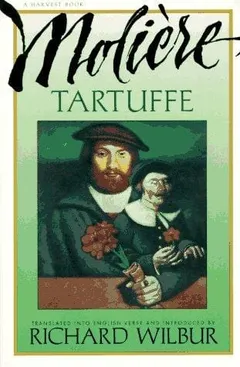
The School for Wives
by Molière · L'École des femmes
Assigned by 2 of the 9 reading lists
Arnolphe, a man in his forties terrified of being cuckolded, has raised the orphan Agnès from childhood in complete ignorance so that she will make an obedient wife. Days before the wedding a young man, Horace, meets Agnès by chance and falls in love, and, not knowing who Arnolphe is, confides every step of the courtship to him. Agnès learns more from a few days of love than from years of confinement, and Arnolphe's scheme collapses. The play's success provoked a public quarrel that Molière answered on stage in The Critique of the School for Wives.
We recommendThe School for Wives and The Learned Ladies, translated by Richard WilburHarcourt, 1991Wilbur's verse translation, paired with a later comedy on the same theme.
As an Amazon Associate, The Great Books earns from qualifying purchases. Bookshop.org links also support this site. How this works.
- Written
- 1662
- Form
- Comedy
- Language
- French
- Length
- Short · 100 ppunder 120 pages
- Difficulty
- Approachable1 of 5 for a first-year reader
Why it's on the list
The School for Wives is the play that made Moliere and nearly unmade him. Its premise, a man in his forties who has raised a girl in deliberate ignorance from the age of four in order to marry someone too stupid to deceive him, was found indecent and irreligious by a substantial part of Paris, and the row that followed, the Quarrel of the School for Wives, ran for two years and produced rival plays, pamphlets and a royal pension. It matters now for a different reason. Arnolphe's scheme is an argument about what women are for, stated at length and in detail, and Moliere lets it be demolished not by a raisonneur but by the girl herself, who learns more in a week of being loved than in thirteen years of being kept. It is also the first French comedy in five acts and verse to be taken as seriously as a tragedy.
Key themes
- Women and men
- Arnolphe's maxims of marriage, which he makes Agnes read aloud, are a complete programme: she is to have no will, no mirror, no visitors and no writing, and the play's method is to let him state it fully before it fails.
- Education
- The title is ironic twice over. Arnolphe's school produces a wife who cannot be held, and the real education happens in a few days and is conducted by a boy who tells her nothing except that he loves her.
- Power and authority
- The comic engine is that Horace, not knowing who Arnolphe is, confides each step of the courtship to him. Arnolphe therefore knows everything and can prevent nothing, which is the position his whole scheme was designed to avoid.
- Love and desire
- Agnes' development is the play's real subject. She begins unable to understand a question and ends able to tell the man who owns her that he should have taught her to be lovable if he wanted to be loved.
Which translation to read
Our pick
The School for Wives and The Learned Ladies, translated by Richard Wilbur
Harcourt, 1991
Wilbur's verse translation, paired with a later comedy on the same theme.
Amazon: the Richard Wilbur translation, opens in a new tabBookshop.org: the Richard Wilbur translation, opens in a new tab
Overview
The School for Wives is five acts in rhymed alexandrines, about a hundred pages, first performed at the Palais-Royal in December 1662. It was Moliere’s first full-length verse comedy in five acts, which in the hierarchy of the period meant claiming for comedy the form reserved for tragedy, and it was an enormous popular success and an enormous scandal.
The scandal is part of the work. Rivals and devout critics attacked it for indecency, for mocking religion by putting the maxims of marriage in the form of a devotional exercise, and for a series of double meanings, one of which, about what Agnes let Horace take from her, kept Paris arguing for months. Moliere answered on stage twice, with The Critique of the School for Wives, a one-act play consisting of people in a drawing room arguing about The School for Wives, and then with The Impromptu of Versailles. Louis XIV settled it by granting him a pension.
He was forty and had just married Armande Bejart, who was twenty, which is roughly the arrangement Arnolphe is attempting, and contemporaries said so loudly.
The structure has one striking feature: almost nothing is dramatised. Horace narrates each development to Arnolphe, so the audience learns the plot in reported speech from a young man who does not know he is telling it to his rival. It should be undramatic and it is the funniest thing in the play.
What happens
Act I. Arnolphe explains himself to his friend Chrysalde, and the explanation is the play’s premise. He has spent his life laughing at cuckolds and is determined never to be one. His solution is to have taken a peasant child, Agnes, at the age of four, put her in a convent with instructions that she be made as stupid as possible, and brought her up in a house of his own where she sees nobody. She is now old enough to marry and he intends to marry her. He offers as evidence of his success the story of her asking, in all innocence, whether children are made through the ear.
Chrysalde suggests that a stupid wife may be as dangerous as a clever one and is ignored.
Then Horace arrives, the son of Arnolphe’s old friend, newly in town and full of an adventure: he has seen a beautiful girl kept under guard by a ridiculous old man, has contrived to meet her, and she loves him. He asks Arnolphe for money and confides everything, and he does not know that the ridiculous old man is standing in front of him, because Arnolphe has lately taken to calling himself Monsieur de la Souche.
Act II. Arnolphe interrogates Agnes, who tells him the whole story without the slightest sense that anything is wrong, in a scene built on her taking every question literally. She reports that Horace took something from her, and lets Arnolphe writhe through several exchanges before revealing that it was a ribbon.
He then tells her she is to be married the next day, which delights her until she learns to whom.
Act III. Arnolphe’s counter-attack, and the centre of the play. He lectures her on the duties of a wife, in a speech about hell and boiling cauldrons, and then gives her a printed sheet, The Maxims of Marriage, and has her read them aloud. There are supposed to be eleven; she reads ten and breaks off, and each one is a further reduction: she belongs to him alone, she may not receive visitors, she may not dress to please anyone else, no mirrors, no writing materials, no parties, no gambling, no walks without him.
Afterwards Horace appears and reports the next development. Agnes threw a stone at him from the window, as instructed, and attached to it a letter. He reads it aloud. It is the first thing she has ever written, it apologises for not knowing how to write properly, it says she has been told that everything she wants to do is wicked and that she is afraid it may be true but does not believe it, and it asks him to tell her the truth.
Arnolphe, alone, admits what has happened: love is a great master, and the girl he kept ignorant has learned in a few days what he prevented for thirteen years.
Act IV. Arnolphe bribes the servants to keep Horace out, and Horace reports being beaten and playing dead, and then that Agnes has let him into her room.
Act V. Horace, needing somewhere safe to put Agnes, entrusts her to the only respectable man he knows, which is Arnolphe. Arnolphe therefore ends up with her and with the confession, and makes his last attempt, offering money, clothes, anything, and demanding to know why she cannot love him.
Her answer is the play. Horace, she says, made her want to do things, and Arnolphe never did. Why did he not make himself lovable? She was not prevented from loving; he simply failed to be worth it.
The resolution is machinery. Horace’s father arrives with a marriage already arranged for his son, which turns out, after a recognition scene involving a long-lost brother in America, to be with Agnes herself, who is the man’s daughter. Arnolphe leaves the stage without a word, which in performance is either the funniest moment in the play or the bleakest.
How to read it
Read Wilbur’s translation, which keeps the couplets and is the best English version of any Moliere.
Watch the reported-speech device. Every major event reaches the audience through Horace telling Arnolphe about it, and the pleasure is entirely in Arnolphe’s face while he listens. It is a structural joke sustained for five acts.
Follow Agnes’ language. She begins with the shortest, plainest sentences in the play, uses them to devastating effect without intending to, and by the last act is arguing. Moliere gives her no scene of transformation; the change is audible in the way she talks.
Take Arnolphe’s programme seriously as an argument before laughing at it. He states a position about the relation between ignorance and obedience that was widely held, and the play refutes it by experiment rather than by assertion.
Read the Critique of the School for Wives afterwards if you can find it. It is Moliere putting the objections to his own play into the mouths of characters and answering them on stage, which is a bolder piece of theatre than the play it defends.
And read it next to A Doll’s House. Two hundred and seventeen years apart, both about a man who wants a wife kept childish, and in one of them the arrangement collapses in comedy and in the other it collapses with a door closing.
Questions it raises
- Arnolphe’s scheme fails. Does the play argue that it could never work, or only that he executed it badly?
- Agnes is not educated by anyone; she is loved. Is the play claiming that feeling teaches what instruction cannot?
- The ending is pure machinery. Does the recognition scene rescue the play or evade the problem it has raised?
- Arnolphe is ridiculous and he is also genuinely in love by the last act. How much sympathy does the play permit him?
- Moliere was forty and had just married a twenty-year-old. Does the biography change how the play reads, and should it?
- The scandal was about indecency and impiety. What was Paris actually objecting to?
Highlights
She was so innocent that when I asked her what was troubling her, she answered that the kitten had died.
Paraphrase of Arnolphe boasting to Chrysalde about the quality of Agnes' ignorance, and the anecdote he offers as proof that his method is working.
Marriage, Agnes, is no laughing matter. The duties of a wife are strict, and the position I am raising you to is not one of pleasure and liberty.
Paraphrase of the speech that precedes the maxims, which Arnolphe makes her read aloud and which she gets through ten of before he stops her.
Why did you not make yourself lovable? I did not prevent you. Whose fault is it if you are not loved?
Paraphrase of Agnes' answer when Arnolphe demands to know why she loves Horace and not him, and the moment the play hands her the argument.
Love is a great master. What we never were teaches us to be.
Paraphrase of Arnolphe's own admission, made in soliloquy, that the girl he kept stupid has become quick, and that he can see exactly why.