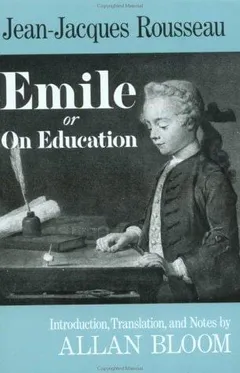
Emile
by Jean-Jacques Rousseau · Émile, ou De l'éducation
Assigned by 1 of the 9 reading lists
A treatise on education cast as the story of an imaginary pupil, Emile, raised by a tutor from infancy to marriage. Rousseau argues that children should learn from things and experience rather than from books and precepts, that reasoning comes late, and that the aim is a man who is at once natural and fit to live among others. Book IV contains the Profession of Faith of the Savoyard Vicar, and Book V introduces Emile's bride Sophie and the education of women. The book was burned in Paris and Geneva.
We recommendEmile, or On Education, translated by Allan BloomBasic Books, 1979The standard complete translation, with an introduction that explains why the book matters for politics as well as pedagogy.
As an Amazon Associate, The Great Books earns from qualifying purchases. Bookshop.org links also support this site. How this works.
- Written
- 1762
- Form
- Treatise
- Language
- French
- Length
- Long · 500 pp300 to 700 pages
- Difficulty
- Demanding3 of 5 for a first-year reader
Allan Bloom translation
Buy on Amazon: Emile, opens in a new tabBookshop.org: Emile, opens in a new tab
Why it's on the list
Rousseau's insistence that children should learn from things and experience rather than from books and precepts challenges an entire inherited pedagogical tradition centered on authoritative text and verbal instruction, proposing instead direct engagement with the physical world as education's genuine primary foundation. His claim that reasoning comes late reorders the traditional sequence of educational development, insisting the young child's mind requires sensory and practical formation well before abstract rational capacity can meaningfully develop or be productively engaged through instruction. Casting this treatise as the story of an imaginary pupil raised from infancy to marriage lets Rousseau work out his educational theory through sustained fictional narrative rather than only abstract prescription, showing rather than merely asserting how his proposed method might unfold across an entire developing life. Book IV's Profession of Faith of the Savoyard Vicar and Book V's introduction of Sophie and the education of women extend the treatise beyond pedagogical method alone into natural religion and gender, provoking controversy severe enough that the book was burned in both Paris and Geneva shortly after publication.
Key themes
- Education
- Rousseau's insistence that children should learn from things and experience rather than from books and precepts challenges an entire inherited pedagogical tradition, proposing direct engagement with the physical world as education's genuine primary foundation.
- The good life
- Rousseau's claim that reasoning comes late reorders the traditional sequence of educational development, insisting the young child's mind requires sensory and practical formation before abstract rational capacity can meaningfully develop toward a fully realized life.
- Women and men
- Book V introduces Emile's bride Sophie and the education of women, extending the treatise's pedagogical concerns into gender, proposing a genuinely distinct educational approach for women that provoked considerable subsequent controversy and criticism.
- God and faith
- Book IV contains the Profession of Faith of the Savoyard Vicar, extending the treatise beyond pedagogical method alone into natural religion, a controversial theological digression that helped ensure the book's condemnation and burning in Paris and Geneva.
Which translation to read
Our pick
Emile, or On Education, translated by Allan Bloom
Basic Books, 1979
The standard complete translation, with an introduction that explains why the book matters for politics as well as pedagogy.
Amazon: the Allan Bloom translation, opens in a new tabBookshop.org: the Allan Bloom translation, opens in a new tab
Overview
About five hundred pages, Jean-Jacques Rousseau’s treatise on education, published in 1762, cast as the story of an imaginary pupil, Emile, raised by a tutor from infancy to marriage. Rousseau argues that children should learn from things and experience rather than from books and precepts, that reasoning comes late.
The aim is a man who is at once natural and fit to live among others. Book IV contains the Profession of Faith of the Savoyard Vicar, and Book V introduces Emile’s bride Sophie and the education of women. The book was burned in Paris and Geneva.
What happens
Learning from things, not books. Rousseau opens by arguing that children should learn from things and direct experience rather than from books and precepts, establishing his central pedagogical departure from inherited educational tradition.
Reasoning comes late. Rousseau insists that reasoning comes late in a child’s development, reordering the traditional educational sequence to prioritize sensory and practical formation before abstract rational instruction becomes appropriate.
Emile’s early education. The tutor guides Emile through carefully structured early experiences, allowing natural consequences and direct engagement with the physical world to teach lessons no book or verbal precept could as effectively convey.
The Profession of Faith. Book IV contains the Profession of Faith of the Savoyard Vicar, a substantial theological digression extending the treatise into natural religion and provoking considerable controversy well beyond its immediate pedagogical context.
Introducing Sophie. Book V introduces Emile’s bride Sophie, extending Rousseau’s educational theory into the specific question of how women should be educated, proposing an approach he presents as genuinely distinct from Emile’s own formation.
The aim: natural and social. The treatise concludes by aiming at a man who is at once natural and fit to live among others, Rousseau’s considered synthesis of individual authentic development and social capacity.
How to read it
Read Rousseau’s insistence that children should learn from things and experience rather than from books and precepts as challenging an entire inherited pedagogical tradition centered on authoritative text, proposing direct engagement with the physical world as education’s genuine foundation.
Pay close attention to how the claim that reasoning comes late reorders the traditional sequence of educational development, insisting the young child’s mind requires sensory and practical formation before abstract rational capacity can meaningfully develop or be engaged.
Notice how casting this treatise as the story of an imaginary pupil raised from infancy to marriage lets Rousseau work out his educational theory through sustained fictional narrative, showing rather than merely asserting how his proposed method might unfold across a life.
Consider how Book IV’s Profession of Faith and Book V’s treatment of Sophie’s education extend the treatise beyond pedagogical method alone into natural religion and gender, provoking controversy severe enough that the book was burned in both Paris and Geneva.
Read this treatise alongside Rousseau’s own Social Contract to see how the individual, natural development traced here in Emile’s education connects to and prepares for the civic and political questions his companion work addresses about legitimate collective authority.
Questions it raises
- Does Rousseau’s insistence that children should learn from things and experience rather than books successfully identify a genuine pedagogical improvement, or does this approach underestimate the value of accumulated cultural and textual knowledge that direct experience alone cannot efficiently convey?
- How persuasive is the claim that reasoning comes late in child development? Does delaying abstract instruction until later stages match how children actually develop cognitively, or might earlier reasoning capacity be more available than Rousseau’s framework allows?
- What does casting the treatise as Emile’s fictional developmental narrative accomplish that a more purely theoretical treatise could not? Does this literary approach strengthen the pedagogical argument, or does fictional narrative risk obscuring genuine practical applicability?
- How should a reader weigh Book V’s treatment of Sophie’s education against Emile’s own more extensively developed formation? Does Rousseau’s proposed difference between educating men and women reflect defensible distinct purposes, or problematic assumptions about gender that undermine his broader educational philosophy?
- Given that this book was burned in both Paris and Geneva, what does this reception suggest about which elements, the pedagogical theory or the Savoyard Vicar’s religious profession, contemporaries found most genuinely threatening to established authority and orthodoxy?
- What does this treatise’s continued influence on educational theory and practice suggest about the durability of Rousseau’s core insights, learning through experience, respecting developmental stages, despite the considerable controversy surrounding its other more specifically dated claims about religion and gender?
Highlights
Rousseau argues that children should learn from things and experience rather than from books and precepts, that reasoning comes late, and that the aim is a man who is at once natural and fit to live among others, a considerable pedagogical challenge to inherited tradition.
Paraphrase of Rousseau's central educational thesis, experience over text and delayed rather than early reasoning.
This treatise on education is cast as the story of an imaginary pupil, Emile, raised by a tutor from infancy to marriage, letting Rousseau work out his educational theory through sustained fictional narrative rather than only abstract prescription.
Paraphrase of the treatise's distinctive literary form, educational theory embodied in an extended fictional pupil's developing life.
Book IV contains the Profession of Faith of the Savoyard Vicar, and Book V introduces Emile's bride Sophie and the education of women, extending the treatise into natural religion and gender in ways that provoked the book's burning in Paris and Geneva.
Paraphrase of the treatise's most controversial later sections, extending beyond pedagogy into religion and gender.