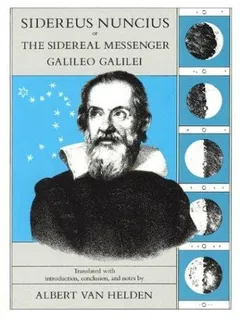
Dialogues Concerning Two New Sciences
by Galileo Galilei · Discorsi e dimostrazioni matematiche intorno a due nuove scienze
Assigned by 3 of the 9 reading lists
Galileo's last book, written blind and under house arrest after his condemnation, and smuggled out to be printed in Leiden. Over four days the same three speakers from the book that got him tried, Salviati, Sagredo and Simplicio, take up two subjects nobody had made a science of: the strength of materials and the motion of bodies. The first two days treat cohesion, why a beam breaks where it does, why a larger animal cannot simply be a scaled-up small one, the vacuum and the paradoxes of the infinite. The third and fourth establish that a falling body gains speed in proportion to elapsed time and covers distance as the square of it, and that a projectile traces a parabola.
We recommendDialogues Concerning Two New Sciences, translated by Henry Crew and Alfonso de SalvioDover, 1954The 1914 translation used by Great Books; Stillman Drake's Wisconsin translation is more accurate but harder to find.
Also goodcompare
- Stillman Drake. The modern scholarly translation, better than Crew and de Salvio on the technical passages and with notes by the leading Galileo scholar.
As an Amazon Associate, The Great Books earns from qualifying purchases. Bookshop.org links also support this site. How this works.
- Written
- 1638
- Language
- Italian
- Length
- Medium · 300 pp120 to 300 pages
- Difficulty
- Difficult4 of 5 for a first-year reader
Henry Crew and Alfonso de Salvio translation
Buy on Amazon: Dialogues Concerning Two New Sciences, opens in a new tabBookshop.org: Dialogues Concerning Two New Sciences, opens in a new tab
Why it's on the list
This is the book that founded physics, and Galileo wrote it as a condemned man. After the trial of 1633 he was forbidden to publish, confined to his villa outside Florence and going blind, and he returned to work he had begun forty years earlier and had put aside for astronomy. What he produced is the first sustained demonstration that motion can be described by mathematics: not that heavy things fall faster, which is Aristotle and is what everyone believed, but that all bodies accelerate alike, that the acceleration is uniform, that distance goes as the square of the time, and that a projectile's path is a parabola. Newton's first two laws are a generalisation of what is proved here. The first two days, on why structures break and why animals cannot be scaled up indefinitely, quietly founded engineering as well.
Key themes
- Science and method
- Galileo idealises deliberately. He treats motion without resistance, which nobody can observe, on the argument that you must first find the law and then account for the interference, and this is the move that makes mathematical physics possible.
- Nature and the cosmos
- The same mathematics applies to a falling stone and to a cannonball and, by implication, to the heavens. The old division between the corruptible sublunary world and the perfect celestial one has no place left to stand.
- Knowledge and truth
- The dialogue form lets Galileo raise objections through Simplicio and answer them, and lets him publish conclusions the Inquisition had forbidden him to assert, since a character is speaking.
Which translation to read
For Dialogues Concerning Two New Sciences the translation is most of the decision. Our pick is the Henry Crew and Alfonso de Salvio translation; the other is good for different reasons.
Our pick
Dialogues Concerning Two New Sciences, translated by Henry Crew and Alfonso de Salvio
Dover, 1954
The 1914 translation used by Great Books; Stillman Drake's Wisconsin translation is more accurate but harder to find.
Amazon: the Henry Crew and Alfonso de Salvio translation, opens in a new tabBookshop.org: the Henry Crew and Alfonso de Salvio translation, opens in a new tab
Also good
Two New Sciences, translated by Stillman Drake
Wall and Emerson, 2000
The modern scholarly translation, better than Crew and de Salvio on the technical passages and with notes by the leading Galileo scholar.
Amazon: the Stillman Drake translation, opens in a new tabBookshop.org: the Stillman Drake translation, opens in a new tab
Overview
Two New Sciences is three hundred pages, cast as a conversation over four days between three men in a Venetian shipyard. Salviati speaks for Galileo, Sagredo is the intelligent layman who asks the right questions, and Simplicio defends Aristotle. They are the same three characters from the Dialogue Concerning the Two Chief World Systems, the book that got Galileo tried and condemned in 1633.
The circumstances of its writing are part of its meaning. Galileo was seventy-four, under permanent house arrest at Arcetri, forbidden to publish anything, and had gone blind. The manuscript was smuggled to the Netherlands and printed at Leiden in 1638 by the Elzevirs, out of reach of the Roman censors, with a preface in which the publisher claims Galileo had nothing to do with it.
There is a common assumption that this was a book about astronomy. It is not. Galileo returned to problems he had worked on at Padua decades earlier and had abandoned when the telescope made him famous, and the subject is terrestrial: why beams break, and how things fall. That turns out to matter far more.
The form is mixed and can be awkward. The first two days are conversation. The third and fourth days are conversation wrapped around a Latin treatise which Salviati reads aloud, with propositions, theorems and proofs in the manner of Euclid, and the others interrupting.
The argument
First Day: cohesion, the vacuum and the infinite. It opens in the arsenal at Venice with a practical puzzle: why do large machines and large structures fail where small ones of the same design do not?
Galileo’s answer, developed on the Second Day, is the square-cube relation. Scale a shape up and the area of its cross-sections grows as the square of the linear dimension while its weight grows as the cube, so strength cannot keep pace with load. A beam twice as long and twice as thick is relatively weaker. A giant built to human proportions would be crushed by his own frame. Nature therefore cannot make trees or animals beyond a certain size without changing their proportions, which is why the bones of large animals are disproportionately thick.
The rest of the First Day ranges widely: what holds matter together, whether a vacuum can resist separation, why a pump cannot lift water beyond about thirty-four feet, the behaviour of pendulums, and a long and genuinely strange excursion into the paradoxes of the infinite. Salviati shows that the squares can be put in one-to-one correspondence with all the integers even though most numbers are not squares, and concludes that the attributes greater, less and equal simply do not apply to infinite quantities. That is Galileo’s paradox, and it is a real anticipation of Cantor.
Also here is the refutation of Aristotle on falling bodies, done by argument rather than by dropping anything. Suppose a heavy body falls faster than a light one. Tie them together. The lighter should retard the heavier, so the combination falls slower than the heavy body alone. But the combination is heavier than either, so it should fall faster. The premise generates a contradiction and must go. Whether Galileo ever dropped weights from the tower at Pisa is doubtful; this argument needs no tower.
Second Day: the strength of materials. A systematic treatment of beams: how a loaded beam breaks, where it breaks, how strength varies with length, thickness and how it is supported, and the shape a beam should have to be equally strong along its length. This is the founding text of the strength of materials, and although some of Galileo’s numbers are wrong, because he misjudged how stress distributes across a section, the questions and the method are right.
Third Day: motion. The heart of the book. Galileo defines uniform motion, then defines uniformly accelerated motion as motion that gains equal increments of speed in equal times, and notes that this is a definition rather than an observation: the question is whether nature uses it.
From the definition he proves the two central results. The mean speed theorem, that a uniformly accelerated body covers the same distance as a body moving throughout at the average of its initial and final speeds. And the times-squared law, that distances from rest are as the squares of the elapsed times, so a body falls one unit in the first interval, three in the second, five in the third, in the odd numbers.
He could not test this with free fall, which is far too fast to time with the water clocks available. So he rolled bronze balls down a grooved inclined plane, slowing the process without changing its character, and argued that what holds on the incline holds in the limit for vertical fall. The passage describing the apparatus, the groove lined with parchment, the water weighed to measure time, and the repetitions, is one of the first detailed accounts of experimental procedure in Western science.
Fourth Day: projectiles. Galileo separates a projectile’s motion into two independent components, a uniform horizontal motion and a uniformly accelerated vertical one, and shows that compounding them yields a parabola. He derives the range, notes that forty-five degrees gives the maximum, and tabulates the results for gunners. The principle that independent motions superpose without interfering is as important as the parabola.
How to read it
Read the First Day for the argument against Aristotle and the square-cube reasoning, the Third Day for the law of fall and the inclined plane, and the Fourth Day for the parabola. The Second Day is for engineers.
Follow the inclined-plane passage closely and ask what is being assumed. Galileo cannot observe free fall, so he measures something else and argues that the law carries over. That inference is doing enormous work and it is worth deciding whether it holds.
Notice the idealisation. Galileo throws away air resistance, friction and the resistance of the medium, on the explicit ground that you have to find the underlying law first and add the complications afterwards. Simplicio objects that real bodies do not behave this way, and he is right, and Galileo is righter.
Read Simplicio charitably. He is set up to lose, but the Aristotelian position he defends is not stupid, and in ordinary experience a feather does fall more slowly than a stone.
Keep the biography in view. A blind old man under house arrest, forbidden to publish, returning to work he had set aside thirty years before and getting it out of the country, is not incidental colour. It is why the book exists.
Questions it raises
- Galileo defines uniform acceleration and then asks whether nature uses that definition. What kind of question is that, and how would you settle it?
- The law of fall is established on inclined planes and asserted for free fall. Is the extrapolation justified?
- He idealises away resistance and friction. When is it legitimate to describe a motion nobody can observe?
- The square-cube argument sets limits on the size of animals and buildings. Why had nobody noticed?
- Galileo’s paradox shows the squares can be matched one-to-one with all the numbers. He concludes that comparison breaks down for infinities. Was there a better conclusion available to him?
- This is a book about beams and falling stones, written by a man condemned over the motion of the earth. Did he choose the subject to be safe, or because he thought it was the more important one?
Highlights
The spaces described by a body falling from rest with a uniformly accelerated motion are to each other as the squares of the time intervals employed in traversing these distances.
If two stones of different weight are tied together, the slower should retard the faster and the faster hurry the slower, so that the pair moves more slowly than the heavier alone, and yet the pair is heavier than either.
Paraphrase of the thought experiment that refutes Aristotle without dropping anything, by deriving a contradiction from his own premise.
A projectile which is carried by a uniform horizontal motion compounded with a naturally accelerated vertical motion describes a path which is a semi-parabola.
You cannot build ships, palaces or temples of enormous size in such a way that their oars, yards, beams and bolts will hold together; nor can nature produce trees of extraordinary size, because the branches would break down under their own weight.
Paraphrase of the square-cube argument, which is why a giant would be crushed by his own bones and why engineering cannot proceed by scaling a model up.