On the Soul
by Aristotle · Περὶ ψυχῆς
Assigned by 4 of the 9 reading lists
Aristotle's treatise on what it is to be alive. After reviewing and dismantling earlier theories, he defines the soul not as a thing inside the body but as the form of a living body, the first actuality of something organised to live. He then studies the powers of soul in order: nutrition and reproduction, perception through each of the five senses, imagination, and finally thought. Book III contains the brief, obscure and much-disputed chapters on the intellect that becomes all things and the intellect that makes them, which occupied medieval philosophy for centuries.
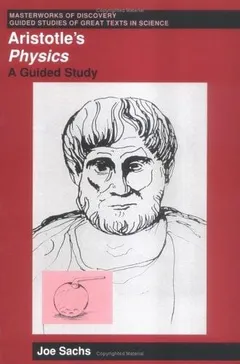
We recommendAristotle's On the Soul and On Memory and Recollection, translated by Joe SachsGreen Lion Press, 2001Literal and carefully consistent, with an introduction that walks through the argument.
Also goodcompare
- Christopher Shields. The Clarendon translation with a commentary that is the standard reference for the hard chapters of Book III.
- Princeton University Press. J. A. Smith's revised Oxford translation, useful if you want the wording most older commentaries quote.
As an Amazon Associate, The Great Books earns from qualifying purchases. Bookshop.org links also support this site. How this works.
- Written
- c. 350 BCE
- Form
- Treatise
- Language
- Greek
- Length
- Short · 100 ppunder 120 pages
- Difficulty
- Difficult4 of 5 for a first-year reader
Why it's on the list
This is where the mind-body problem gets its first serious answer, and the answer is one that neither side of the modern quarrel gives. For Aristotle the soul is not a substance lodged in a body, as it is for Plato and later for Descartes, nor is it simply the body's matter. It is what the body is organised to do, which is why asking whether soul and body are one is, he says, like asking whether the wax and its shape are one. That single move generated the entire medieval psychology of Aquinas and the Islamic commentators, and it is why the treatise keeps reappearing in contemporary philosophy of mind under the name functionalism. It is also the only place Aristotle says anything about whether something in us survives death, and what he says there is three sentences long and has never been settled.
Key themes
- The self and identity
- Aristotle refuses to make the soul an occupant of the body. It is the body's form, so there is no question of it getting in or out, and the person is not a pilot in a ship.
- Knowledge and truth
- Perceiving is receiving a form without the matter, and thinking is the same operation one level up. The mind becomes what it thinks, which is why Aristotle can say the soul is in a way all things.
- Nature and the cosmos
- The study of soul is a branch of natural science. Life is arranged in a nested series of powers, nutrition, perception, thought, each presupposing the one below, which orders the whole living world.
- Death and mortality
- The one intellect Aristotle calls separable, unaffected and unmixed is also the one he says is deathless and eternal, and he does not say whose it is. Every later reader had to decide.
Which translation to read
For On the Soul the translation is most of the decision. Our pick is the Joe Sachs translation; the others are good for different reasons.
Our pick
Aristotle's On the Soul and On Memory and Recollection, translated by Joe Sachs
Green Lion Press, 2001
Literal and carefully consistent, with an introduction that walks through the argument.
Amazon: the Joe Sachs translation, opens in a new tabBookshop.org: the Joe Sachs translation, opens in a new tab
Also good
De Anima, translated by Christopher Shields
Oxford University Press, 2016
The Clarendon translation with a commentary that is the standard reference for the hard chapters of Book III.
Amazon: the Christopher Shields translation, opens in a new tabBookshop.org: the Christopher Shields translation, opens in a new tab
Also good
The Complete Works of Aristotle, Volume 1, edited by Jonathan Barnes
Princeton University Press, 1984
J. A. Smith's revised Oxford translation, useful if you want the wording most older commentaries quote.
Amazon: the Jonathan Barnes edition, opens in a new tabBookshop.org: the Jonathan Barnes edition, opens in a new tab
Overview
On the Soul is short, roughly a hundred pages, and it is lecture notes rather than a book. Aristotle states a problem, runs through what everyone before him has said, shows why each account fails, and only then gives his own, usually in a sentence so compressed that commentators have been expanding it ever since. Expect no narrative and no rhetoric. Expect distinctions.
The Greek word is psuchē, and “soul” carries the wrong associations in English. Aristotle is not writing about a ghost, a conscience or an afterlife. He is asking what makes the difference between a living thing and a corpse, and his answer covers plants and oysters as readily as people. The treatise is the foundational text of biology and of psychology at once, because for Aristotle they are not two subjects.
The structure is a ladder. Book I clears the ground. Book II gives the definition and then works up from the lowest powers of life. Book III reaches perception’s higher functions and then thought, and breaks off in a series of short, dense chapters that are the most argued-over pages in the corpus.
The argument
Book I is a survey and a demolition. Aristotle takes the existing theories, that soul is fire, or the finest atoms, or a self-moving number, or a harmony of the body’s parts, and asks what each would have to mean. The harmony theory, which is Simmias’ suggestion in Plato’s Phaedo, gets particular attention. Along the way he lays down the constraint that governs the rest: whatever the soul turns out to be, it is not itself a body, and it does not move around.
Book II opens with the definition. A natural body organised for life has both matter and form, and the soul is the form: the first actuality of such a body. The word “first” is doing real work. Knowledge you possess but are not now using is a first actuality; using it is the second. Soul is like the possession, not the exercise, which is why a sleeping animal is still alive. From this Aristotle draws the consequence that makes the treatise famous: you no more need to ask whether soul and body are one than whether the wax and the shape stamped in it are one. And if the eye were a whole animal, its soul would be sight.
He then divides the powers. Nutrition and reproduction come first, shared by everything alive, including plants. Perception comes next, and is defined as receiving the form of a sensible thing without its matter, the way wax takes the seal’s impression and not the iron. Aristotle works through the five senses one at a time, insisting that each needs a medium: sight needs what he calls the transparent, hearing needs air that is struck, and touch, which he treats as the fundamental sense, may be the flesh itself or something beneath it.
Book III begins with the problems perception leaves over. There is no sixth sense, but something must unify what the five deliver, judging that this white thing is also sweet. Then imagination, phantasia, the capacity that leaves images behind after the perception has gone, which can be false where perception of its proper object cannot.
Then thought. Aristotle argues that intellect must be unmixed with body in order to receive all forms, since anything with a nature of its own would distort what it takes in. So the mind before it thinks is like a writing tablet with nothing written on it. In chapter 5 he distinguishes an intellect that becomes all things from an intellect that makes all things, says the latter is separable, unaffected, unmixed, and deathless and eternal, and then moves on. The chapter is less than a page. Whether that intellect is a faculty of yours, a single intellect shared by everyone, or God, divided Alexander of Aphrodisias from Averroes from Aquinas, and the argument is not over.
The last chapters return to earth, explaining how desire and imagination together produce movement in an animal, and why the senses an animal has are the ones its life requires.
How to read it
Start with Book II, chapters 1 to 4, and be sure you can restate the definition in your own words before going further. Everything later depends on it, and everything earlier is preparation.
On a first pass, read Book I quickly. It matters most for what it rules out, and the detail of the refutations can wait.
The individual senses in Book II are interesting but not essential to the argument. Read the chapter on touch, skim the rest, and spend the time saved on Book III.
Read III.4 and III.5 several times, slowly, and then read a commentary. Do not expect to settle them. The honest position after a first encounter is knowing precisely which sentence the difficulty is in.
Watch the vocabulary. Actuality, potentiality, form, matter, and first and second actuality are technical terms carried over from the Physics and Metaphysics, and a translation that renders them loosely will hide the argument. This is why Sachs is worth the awkwardness: he keeps one English word for one Greek word even when it reads strangely.
The standard misreading is to hear “soul” as the Christian soul, and then to find Aristotle either confused or evasive about immortality. He is answering a different question. The single sentence about the deathless intellect is genuinely there, but it is not an account of personal survival, and Aristotle shows no interest in making it one.
Questions it raises
- If the soul is the form of the body, in what sense is a corpse still a body? Aristotle says an eye that cannot see is an eye in name only. Does the same follow for a dead person?
- Perception is said to be receiving a form without the matter. Is that an explanation, or a restatement of the thing to be explained?
- Plants have soul on this account. Does that make the word too wide to be useful, or is the continuity exactly the point?
- The intellect must be unmixed with body to receive all forms. Does that concede what the rest of the treatise denies, that something in us is not the body’s form?
- Aristotle says the soul never thinks without an image. Can that be true of thinking about mathematics, or about the soul?
- If some intellect is deathless and eternal, whose is it, and would its survival be your survival?
Highlights
The soul is the first actuality of a natural body which has life potentially in it.
The definition the rest of the treatise unpacks. The body in question is one that is organised, not merely material.
If the eye were an animal, sight would have been its soul.
The soul is in a way all existing things.
The soul never thinks without an image.
This intellect is separable, unaffected and unmixed, and it alone is deathless and eternal.
Paraphrase of the sentence in III.5 about the intellect that makes all things. Everything that follows in medieval philosophy turns on what it means.