Ethics
by Baruch Spinoza · Ethica Ordine Geometrico Demonstrata
Assigned by 3 of the 9 reading lists
Published after Spinoza's death and set out like Euclid, in definitions, axioms, propositions and demonstrations. Part I argues that there is only one substance, God or Nature, of which everything else is a mode, and that nothing in it is contingent or purposive. Part II treats the human mind as an idea of the body and distinguishes three kinds of knowledge. Parts III and IV analyse the emotions as effects of the one striving Spinoza calls conatus, and argue that we are in bondage as long as we are driven by passions we do not understand. Part V describes the freedom that comes from understanding, and the intellectual love of God.
We recommendEthics, translated by Edwin CurleyPenguin Classics, 1996The clearest modern English, taken from Curley's Collected Works, with the cross-references a first reader needs.
Also goodcompare
- Samuel Shirley. Everything Spinoza wrote in one volume, including the letters, which are often the clearest explanation of what the Ethics is doing.
As an Amazon Associate, The Great Books earns from qualifying purchases. Bookshop.org links also support this site. How this works.
- Written
- 1677
- Form
- Treatise
- Language
- Latin
- Length
- Medium · 280 pp120 to 300 pages
- Difficulty
- Formidable5 of 5 for a first-year reader
Edwin Curley translation
Find this edition: Ethics, opens in a new tabBookshop.org: Ethics, opens in a new tab
Why it's on the list
The Ethics is the most audacious book in modern philosophy: an attempt to demonstrate, in the form of Euclid, with definitions, axioms, propositions and proofs, what God is, what the mind is, why we are not free, and how to be less miserable. Its conclusions got Spinoza expelled from his synagogue at twenty-three under the harshest ban on record and made his name a synonym for atheism for a century, because the God he proves is identical with nature and does nothing for anyone. But the same argument produced the first sustained naturalistic account of the emotions, treating hatred and hope as things with causes to be studied like lines and planes, and a political conclusion that followed from it: that a state should leave people free to think and say what they like, because it cannot do otherwise and should not try.
Key themes
- God and faith
- There is one substance, infinite and self-caused, and Spinoza calls it God or Nature. It has no will, no purpose and no preferences, and everything that exists is a modification of it, including you.
- Fate and freedom
- Everything follows necessarily from the divine nature, so there is no free will. Spinoza's example is a stone in flight which, if it were conscious, would believe it was flying because it wanted to.
- Reason and passion
- Part Three studies the emotions geometrically, as effects with causes. A passion is a state we suffer because we do not understand it, and understanding it is what converts it into something we act from.
- The good life
- Freedom is not the absence of causes but the state of being caused by one's own nature, which requires understanding. The last part calls the result blessedness and says it is not the reward of virtue but virtue itself.
Which translation to read
For Ethics the translation is most of the decision. Our pick is the Edwin Curley translation; the other is good for different reasons.
Our pick
Ethics, translated by Edwin Curley
Penguin Classics, 1996
The clearest modern English, taken from Curley's Collected Works, with the cross-references a first reader needs.
Amazon: the Edwin Curley translation, opens in a new tabBookshop.org: the Edwin Curley translation, opens in a new tab
Also good
Spinoza, Complete Works, translated by Samuel Shirley
Hackett, 2002
Everything Spinoza wrote in one volume, including the letters, which are often the clearest explanation of what the Ethics is doing.
Amazon: the Samuel Shirley translation, opens in a new tabBookshop.org: the Samuel Shirley translation, opens in a new tab
Overview
The Ethics is around three hundred pages and it is written like a geometry textbook. Five parts, each opening with definitions and axioms and proceeding through numbered propositions, each with a demonstration, and many followed by corollaries and by scholia, which are short prose notes where Spinoza explains himself, argues with opponents and occasionally shows feeling. The scholia are where most readers actually live.
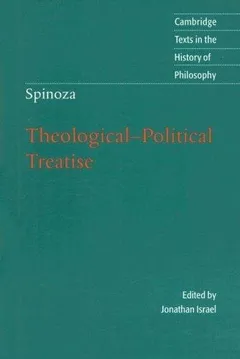
He finished it around 1675 and did not publish. The reaction to his earlier Theological-Political Treatise had been so violent, and rumours of an atheist book in progress so persistent, that he withheld it. It appeared at the end of 1677, months after he died of a lung illness at forty-four, probably worsened by the glass dust from the lenses he ground for a living.
He had been expelled from the Amsterdam Jewish community at twenty-three, by a writ of herem unusual in its ferocity, for opinions that are not specified in the document. He never joined another religious body, refused a professorship at Heidelberg because it came with conditions, and lived quietly in rented rooms.
Reading the geometric form is the practical difficulty. The honest advice is that you cannot verify every demonstration and should not try on a first pass. Read the definitions and axioms of each part, then the propositions as statements, and read every scholium and every preface and appendix carefully. That is where the argument is explained rather than proved.
The argument
Part I: God. Spinoza defines substance as what exists in itself and is conceived through itself, and then argues that there can be only one such thing. Two substances could not share an attribute, nothing outside substance could produce or limit it, and so substance is infinite, unique and self-caused. He calls it God, or Nature, and the phrase, Deus sive Natura, is the whole scandal in two words.
Everything else, including you, this page and every thought, is a mode: a modification of that one substance, not a separate thing. Of the infinite attributes through which substance expresses itself we know two, thought and extension, and these are not two things but one thing described two ways, which dissolves Descartes’ mind-body problem by denying that there are two substances to connect.
This God has no intellect or will resembling ours, no purposes, and makes no choices; things follow from its nature as the properties of a triangle follow from its definition. The appendix to Part I is the most accessible thing in the book and is a sustained attack on teleology: people project purposes onto nature because they act for ends themselves, then invent gods who arranged the world for them, and then have to explain storms and disease, which they do by inventing divine anger. Spinoza calls the whole apparatus a sanctuary of ignorance.
Part II: mind. The human mind is the idea of the body. Mental and physical are one thing under two descriptions, so there is no interaction to explain and no question of one causing the other.
Then a theory of knowledge in three kinds. The first is imagination, built from sensory encounters and hearsay, which is confused and the only source of falsity. The second is reason, which grasps what is common to things and is always true. The third is intuitive knowledge, which proceeds from an adequate idea of God’s attributes to an adequate idea of particular things, and is what Part V is aiming at.
Part III: the emotions. The famous preface announces the method: previous writers have treated human passions as faults or absurdities outside nature, and he will treat human actions and appetites as if they were lines, planes and bodies.
At the centre is conatus, the striving by which each thing endeavours to persist in its own being, which is nothing other than its actual essence. From it he derives three primary affects, desire, joy and sadness, and defines the rest as compounds. Joy is the transition to greater power, sadness to less; love is joy with the idea of an external cause; hatred is sadness with one. He then generates dozens of emotions, including some nobody had named, with the flat precision of a taxonomy.
Part IV: bondage. Why we are at the mercy of our feelings. A passion is an affect of which we are not the adequate cause, arising from inadequate ideas, and it can only be checked by a stronger affect, never by an act of will or by knowing better in the abstract. Reason helps by producing its own affects, and by locating what is genuinely useful to us. Spinoza’s answer to what that is: other people, since nothing is more useful to a human being than another human being living under the guidance of reason, and he argues that a society of rational people would be cooperative for reasons of self-interest correctly understood. It is here that the free man is said to think of nothing less than death.
Part V: freedom. The remedy is understanding. We are passive toward what we do not comprehend; when we form a clear idea of an affect it ceases to be a passion, because the mind is now the adequate cause of its own state. Freedom therefore is not the absence of causes, which is impossible, but being determined by one’s own nature.
The final propositions turn to what Spinoza calls the intellectual love of God, an understanding of things under the aspect of eternity, and to the claim that something of the mind is eternal. Readers have argued since about what he means and whether it is consistent with everything before it. The book ends on the proposition that blessedness is not virtue’s reward but virtue itself, followed by a single sentence: all things excellent are as difficult as they are rare.
How to read it
Read the appendix to Part I first, out of order. It is prose, it is fierce, and it tells you what the geometry is for.
Then read the definitions and axioms of Part I, the propositions as statements, and all the scholia. Come back for the demonstrations later, if at all.
Read the preface to Part III and then the definitions of the affects at the end of it. The taxonomy of emotions is the part of the book that has aged best and it is readable on its own.
Get a companion. Stuart Hampshire’s short study and Steven Nadler’s introduction are both good, and Nadler’s biography explains the expulsion and the world Spinoza lived in.
Do not read God as a synonym for a personal deity being politely relocated. Spinoza’s contemporaries called him an atheist and they had a case; Novalis later called him a God-intoxicated man and he had one too. Working out which is right, or why both feel apt, is the best question the book offers.
Questions it raises
- If there is only one substance and you are a mode of it, in what sense are you a thing at all?
- Spinoza denies free will and writes an ethics. What is left for an ethics to do?
- An affect can only be overcome by a stronger affect, and understanding is said to produce one. Does knowing why you are angry actually reduce the anger?
- The appendix to Part I explains away purposes as human projection. Can that account handle our own purposes without dissolving them too?
- Part V claims something of the mind is eternal. Is that consistent with Part II, and is it a consolation to anyone?
- Was Spinoza an atheist? Both answers have distinguished defenders, and the disagreement may be the most interesting thing about the book.
Highlights
By God I mean an absolutely infinite being, that is, substance consisting of infinite attributes, each of which expresses eternal and infinite essence.
Paraphrase. Everything that shocked Spinoza's contemporaries follows from taking this definition strictly and refusing to add anything to it.
Men believe themselves free because they are conscious of their volitions and their desire, and do not think, even in their dreams, of the causes by which they are disposed to want and to will.
Paraphrase of the argument that the sense of freedom is an effect of ignorance about what is determining us.
I shall consider human actions and appetites just as if I were concerned with lines, planes and bodies.
A free man thinks of nothing less than of death, and his wisdom is a meditation not of death but of life.
Blessedness is not the reward of virtue but virtue itself; nor do we enjoy it because we restrain our lusts. On the contrary, because we enjoy it we are able to restrain them.
The last proposition of the book, followed only by the remark that all things excellent are as difficult as they are rare.