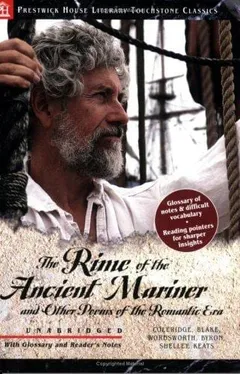
Lyrical Ballads
Assigned by 1 of the 9 reading lists
The small anonymous volume of 1798 by Wordsworth and Coleridge that is usually taken to begin English Romanticism. It opens with Coleridge's Rime of the Ancient Mariner and closes with Wordsworth's Tintern Abbey; between are ballads about beggars, mad mothers, an idiot boy and a girl who insists her dead siblings are still seven. The 1800 second edition added a volume of new poems and Wordsworth's Preface, which defends plain language and defines poetry as the spontaneous overflow of powerful feelings recollected in tranquillity, and the 1802 edition enlarged the Preface into the manifesto it has been read as since.
We recommendLyrical Ballads 1798 and 1800Broadview Press, 2008Michael Gamer and Dahlia Porter print both editions complete, with the Preface, the Appendix and the 1802 additions.
As an Amazon Associate, The Great Books earns from qualifying purchases. Bookshop.org links also support this site. How this works.
- Written
- 1798, expanded 1800 and 1802
- Form
- Lyric poetry
- Language
- English
- Length
- Medium · 250 pp120 to 300 pages
- Difficulty
- Moderate2 of 5 for a first-year reader
Why it's on the list
Writing poems about beggars, mad mothers, an idiot boy and a child who cannot count her dead siblings, in the language really used by men, turned the ordinary rural poor into the subject of serious poetry and made a claim about who deserved attention that was as political as it was literary. Defining poetry in the Preface as the spontaneous overflow of powerful feelings recollected in tranquillity, and the poet as a man speaking to men, gave English poetry its founding modern statement of what a poem is and where it comes from. Opening with the Ancient Mariner and closing with Tintern Abbey set the two poets' gifts side by side, Coleridge's supernatural ballad and Wordsworth's meditation on a landscape revisited, and the volume's range from the one to the other is the range of the Romanticism it began. Being published anonymously in a small edition and attacked by reviewers, then growing through two further editions into a manifesto, gave the movement its founding story of neglect and vindication.
Key themes
- Money and class
- Writing poems about beggars, mad mothers, an idiot boy and the rural poor made a claim about who deserved attention that was as political as it was literary.
- Language and rhetoric
- The Preface defends the language really used by men against poetic diction, and defines the poet as a man speaking to men.
- Art and beauty
- Poetry is the spontaneous overflow of powerful feelings recollected in tranquillity, the founding modern statement of what a poem is and where it comes from.
- Nature and the cosmos
- Tintern Abbey finds in a landscape revisited a presence that disturbs with the joy of elevated thoughts, and the Ancient Mariner is redeemed when he blesses the water-snakes unaware.
- The self and identity
- Tintern Abbey measures the poet's present self against the boy who bounded over the hills five years before, and finds abundant recompense for what is lost.
Which edition to read
Our pick
Lyrical Ballads 1798 and 1800
Broadview Press, 2008
Michael Gamer and Dahlia Porter print both editions complete, with the Preface, the Appendix and the 1802 additions.
Amazon: the Broadview Press edition, opens in a new tabBookshop.org: the Broadview Press edition, opens in a new tab
Overview
About two hundred and fifty pages across both editions, the small anonymous volume of 1798 by Wordsworth and Coleridge that is usually taken to begin English Romanticism. It opens with Coleridge’s Rime of the Ancient Mariner and closes with Wordsworth’s Tintern Abbey; between are ballads about beggars, mad mothers, an idiot boy and a girl who insists her dead siblings are still seven.
The 1800 second edition added a volume of new poems and Wordsworth’s Preface, which defends plain language and defines poetry as the spontaneous overflow of powerful feelings recollected in tranquillity.
What happens
The Ancient Mariner. A wedding guest is stopped by an old sailor who tells how he shot an albatross, how the ship was becalmed and his shipmates died, how he blessed the water-snakes unaware and the spell began to break, and how he must wander telling the tale.
The ballads of the poor. Simon Lee, the old huntsman, weeps with gratitude when the poet cuts a root for him; the girl of We Are Seven will not subtract her dead brother and sister; the Mad Mother sings to her baby; the Idiot Boy is sent on a pony for the doctor and comes home at dawn having seen the owls and the moon.
The Thorn and Goody Blake. A retired sea-captain tells of a woman who sits by a thorn where her child may be buried, and Goody Blake’s curse on the farmer who caught her gathering sticks leaves him cold forever.
Expostulation and reply. In two short poems the poet defends sitting idle on a stone against a friend who tells him to read, arguing that we can feed the mind in a wise passiveness, and that one impulse from a vernal wood teaches more than all the sages.
Tintern Abbey. Revisiting the banks of the Wye after five years, Wordsworth measures his present self against the boy who bounded over the hills, finds a presence in nature that disturbs him with the joy of elevated thoughts, and turns to his sister Dorothy, in whom he sees what he was.
The Preface and the 1800 poems. The second edition adds Michael, the Lucy poems and the Preface, in which Wordsworth explains the experiment, defends the language really used by men, and defines poetry and the poet.
How to read it
Read the 1798 volume first as a small anonymous book, and notice what its ballads of beggars and mad mothers claimed about who deserved attention before the Preface explained it.
Pay close attention to the Preface’s definition of poetry as powerful feeling recollected in tranquillity, and to the second half of the phrase, which most quotations forget.
Notice the range from the Ancient Mariner to Tintern Abbey, the supernatural ballad and the meditation on a landscape, and read it as the range of the Romanticism the volume began.
Consider the reviewers’ attacks and the growth of the book through three editions into a manifesto, and ask what the founding story of neglect and vindication has done to how the poems are read.
Read this volume alongside Coleridge’s Biographia Literaria to hear the other author’s later account of what the experiment was and where he thought Wordsworth’s theory of language went wrong.
Questions it raises
- Did Wordsworth actually write in the language really used by men, and does the Preface describe the poems or a project the poems only partly carried out?
- What does it mean to make an idiot boy or a girl who cannot count her dead siblings the subject of a poem, and is the attention the poems give them respect or condescension?
- Is poetry the spontaneous overflow of powerful feelings, or the recollection in tranquillity, and can the definition hold both?
- How do the Ancient Mariner and Tintern Abbey belong in one book, and what did Coleridge’s later account of the division of labour leave out?
- What does Tintern Abbey find in nature, and is the presence that disturbs with joy a discovery or a consolation for what the boy has lost?
- Why is a small anonymous volume of 1798 usually taken to begin English Romanticism, and what does the choice of a beginning do to the poets who came before?
Highlights
The volume opens with Coleridge's Rime of the Ancient Mariner, in which a sailor shoots an albatross, watches his shipmates die, and is redeemed when he blesses the water-snakes unaware, and must tell his tale forever.
Paraphrase of the volume's opening poem, Coleridge's chief contribution.
Between are ballads of the rural poor, a girl who insists that her dead brother and sister still make seven, a mad mother, an idiot boy sent for the doctor, and an old huntsman whose neighbours will not let him gather wood.
Paraphrase of the volume's experiments in plain subjects and plain speech.
The Preface of 1800 defends the language really used by men, defines poetry as the spontaneous overflow of powerful feelings recollected in tranquillity, and the poet as a man speaking to men, and Tintern Abbey closes the 1798 volume with a landscape revisited after five years.
Paraphrase of the volume's manifesto and its closing meditation.