Discourse on Political Economy
by Jean-Jacques Rousseau · Discours sur l'économie politique
Assigned by 2 of the 9 reading lists
An article Rousseau wrote for volume five of Diderot's Encyclopédie in 1755, later printed separately. It distinguishes the government of a state from that of a family, introduces the concept of the general will as the rule of legitimate administration, and lays out three maxims for rulers, to follow the general will, to cultivate virtue through public education, and to provide for public needs by fair taxation. Rousseau argues that property is the true foundation of civil society, defends progressive taxation on luxury, and insists that the greatest evil is already done when the poor must be defended and the rich restrained. Much of the Social Contract is sketched here seven years before it appeared.
We recommendThe Basic Political Writings, translated by Donald A. CressHackett, 2011The Cress volume includes this essay alongside the Discourses and the Social Contract.
As an Amazon Associate, The Great Books earns from qualifying purchases. Bookshop.org links also support this site. How this works.
- Written
- 1755
- Form
- Political theory
- Language
- French
- Length
- Short · 35 ppunder 120 pages
- Difficulty
- Moderate2 of 5 for a first-year reader
Why it's on the list
Thirty-five pages written for an encyclopedia entry, and the general will appears in them for the first time. Rousseau would give the phrase its famous statement in the Social Contract seven years later, but here it arrives with an emphasis the later book drops: a state is legitimate only when it acts for the common interest rather than for its rulers, and the test of that is not the constitution but what happens to the poor. The essay contains his sharpest sentence on inequality, that the social contract gives the rich everything and the poor nothing, and a case for taxing luxury heavily and necessity not at all. It also introduces the claim that civic virtue must be produced by public education, which is where the argument becomes uncomfortable and interesting at once.
Key themes
- Society and the state
- The state is not a large family. Paternal authority rests on natural affection and physical need, both of which end; political authority rests on convention and can only be justified by the general will of those it binds.
- Justice
- Law is the one institution that raises people above themselves, because obeying a rule you gave yourself is freedom while obeying a person is not. Government is legitimate only as the executor of the law, never its author.
- Money and class
- Rousseau says the poor man's advantage from the social order is that he is confirmed in his misery while the rich are confirmed in their usurpations, and that the state protects property far more than it protects persons.
- Education
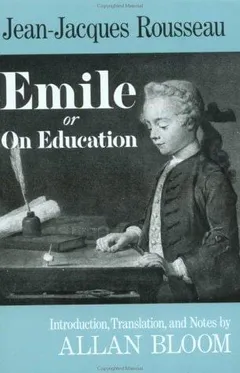
- Virtue cannot be assumed, it has to be made. Rousseau wants a public education that forms citizens who love their country, and cites Sparta and republican Rome, with none of the private tutor's caution he would show in Emile.
Which translation to read
Our pick
The Basic Political Writings, translated by Donald A. Cress
Hackett, 2011
The Cress volume includes this essay alongside the Discourses and the Social Contract.
Amazon: the Donald A. Cress translation, opens in a new tabBookshop.org: the Donald A. Cress translation, opens in a new tab
Overview
Thirty-five pages, written as the article Economie or Oeconomie for the fifth volume of Diderot and d’Alembert’s Encyclopedie, published in 1755 and reprinted separately as a pamphlet three years later.
The date places it exactly. The Discourse on the Origin of Inequality appeared the same year; the Social Contract was seven years off; Emile was written in the same period. This essay sits between the diagnosis and the cure, and much of what it says appears again, differently, in both.
Economy here does not mean what it means now. Rousseau takes the word back to its Greek root, the management of a household, and the essay’s opening move is to deny that the state can be managed that way. What follows is not about markets, prices or trade but about the principles on which a government should administer a people.
It is the most readable of his political writings. There is no state of nature to reconstruct, no conjectural history, and no paradox announced in the first line. He states three maxims and defends them in order, and the prose is direct.
The argument
The state is not a family. He begins by demolishing the analogy that had done service for political theory since Aristotle and had been given its strongest modern form by Filmer.
The differences he names are practical. A father can see his children and knows their needs directly; a ruler cannot, and must work through law. A father’s authority rests on natural affection and on the child’s physical weakness, and expires when the child can look after himself; a ruler has no such foundation. A father’s pleasure is in his children, since he has no interest opposed to theirs; a ruler’s own interest frequently is opposed. And a family’s goods belong to the father, while a state’s belong to the public.
The conclusion is that paternal authority, whatever its merits, cannot be the model, because it explains obedience by nature where political obedience must be explained by agreement.
The general will. Having removed the family, Rousseau needs something to put in its place, and this is where the term enters his work.
The body politic is a moral being with a will, and that will is directed to the preservation and welfare of the whole and of each part. It is the source of law, the standard of justice, and the rule by which anything a government does is judged right or wrong.
Crucially, he distinguishes it from the will of all. A group may want something, and a majority may vote for it, without that being the general will, because a group can want its own advantage at the cost of the whole. The general will is general in its object as well as its source: it concerns everyone equally and cannot pick out individuals.
Rousseau also notes that every partial association within the state has a general will of its own, which is general with respect to its members and particular with respect to the state, and this is why factions are a danger.
He says plainly, and this matters, that the general will is always right and tends to the public advantage, but that it does not follow that the people’s deliberations always have the same rectitude. The people can be deceived about what it wants. That gap is where every objection to this doctrine lives.
First maxim: follow the general will. Government is the executive, not the sovereign. Its job is to administer the law, and its authority is entirely derived from that. When a ruler acts on his own will he ceases to govern and becomes a private person exercising force, and he is owed nothing.
Rousseau adds an argument he returns to often: law is what makes people free, because obeying a law you have a share in making is not subjection, while obeying a man is, however mild he is. Freedom is compatible with law and only with law.
Second maxim: make citizens virtuous. It is not enough to have good laws if the people will not keep them, and Rousseau does not believe that self-interest can be relied on to produce civic behaviour. What is needed is virtue, meaning the conformity of the particular will to the general one, and virtue has to be formed.
The instruments are patriotism, which he treats as the strongest of social sentiments and thinks can be deliberately cultivated; the example of the magistrates, since a people copies what it sees at the top; and above all public education. Children should be educated together, in the principles of the state, by public authority, and become accustomed to seeing themselves only in their relation to the body of the state.
He cites Sparta, Crete and the Roman republic. Anyone who has read Emile, where a single child is raised in the country away from society and its opinions, will notice that these are not obviously the same author, and the tension between the citizen and the man is one Rousseau never resolved and knew he had not.
Third maxim: provide for public needs. The practical section, and the sharpest.
Rousseau argues that the state must raise revenue but that taxation is the point at which a government’s real character shows. He opposes taxes on necessities and on persons, since these fall hardest on those who have least. He wants taxes weighted against luxury, and works through what that means: taxes on carriages, on liveried servants, on ornament, on anything whose possession announces that its owner has more than he needs. He also prefers, where it is available, that the state be funded from public domains rather than from levies at all.
Behind the fiscal detail is the political claim. He points out how little the poor get from the social order and how much the rich do: the law protects property more zealously than persons, the burdens fall on those least able to bear them, and the whole arrangement, honestly stated, is an offer from the rich to the poor to be allowed the honour of serving.
And he warns that a state cannot correct extreme inequality once it exists, because by then the rich control the means of correcting it. The task is to prevent accumulation before it happens.
How to read it
Read it before the Social Contract, not after. It is shorter, clearer, and it introduces the general will in a context where you can see what problem the term is meant to solve.
Mark the passage distinguishing the general will from the will of all, and the admission that the people can be deceived. Every later use of Rousseau, benign and otherwise, turns on how that gap is filled, and he does not fill it here.
Read the taxation section closely. It is the most concrete political writing he ever did, and it is a genuine piece of fiscal argument, not a rhetorical gesture.
Put the education section beside Emile and let them argue. One wants citizens formed in common by the state; the other wants a boy kept away from society until his judgement is his own. Rousseau said in Emile that you must choose between making a man and making a citizen, and this essay is what choosing the citizen looks like.
Remember the venue. This went into the Encyclopedie, the great collaborative project of the French Enlightenment, and the standard of the surrounding articles is competent and moderate. Rousseau uses the space to say that the existing arrangement between rich and poor is a fraud. That is worth noticing.
Questions it raises
- If the general will is always right but the people may be mistaken about it, who is entitled to say what it is?
- Rousseau says obeying law you helped make is freedom. Does that hold when you voted against it?
- Is patriotism something a government can manufacture, and should it try?
- Public education that teaches children to see themselves only as members of the state: civic formation or indoctrination?
- He says extreme inequality must be prevented rather than corrected. Is prevention available to a state that already has it?
- The state is not a family. What, if anything, does the family analogy still explain about political obligation?
Highlights
The most pressing interest of the ruler, as also his most indispensable duty, is therefore to watch over the observation of the laws of which he is the minister and on which his whole authority is founded.
You need me, for I am rich and you are poor. Let us therefore make an agreement: I will permit you to have the honour of serving me, on condition that you give me what little you have left for the trouble I shall take in commanding you.
Paraphrase of Rousseau's summary of the terms the rich offer the poor, delivered as the true content of the social contract as it actually exists.
It is therefore one of the government's most important tasks to prevent extreme inequality of fortunes, not by taking treasures from their possessors, but by depriving everyone of the means of accumulating them.
It is certain that all peoples become in the long run what the government makes them: warriors, citizens, men when it so pleases; populace and rabble when it chooses.
Nothing is more necessary for a tax to be just than that its yield should be taken from what is superfluous, and nothing more unjust than to take from what is needed.
Paraphrase of the third maxim, which works out a scheme in which necessities go untaxed and luxuries carry the burden.