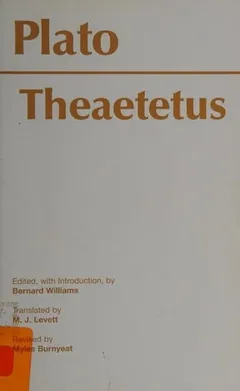
Sophist
by Plato · Σοφιστής
Assigned by 2 of the 9 reading lists
A visitor from Elea, with the young mathematician Theaetetus as respondent, sets out to define the sophist by the method of division, splitting kinds in two until the quarry is cornered. Defining the sophist as a maker of false images requires explaining how anything can be false, which means saying that what is not in some way is, against Parmenides. The visitor commits this parricide, distinguishes five great kinds including Being, Sameness and Difference, and gives an account of false statement.
We recommendComplete Works, translated by Nicholas P. White, in the volume edited by John M. CooperHackett, 1997The Cooper collection is the standard reference edition and includes this dialogue in a clear translation.
As an Amazon Associate, The Great Books earns from qualifying purchases. Bookshop.org links also support this site. How this works.
- Written
- c. 360 BCE
- Language
- Greek
- Length
- Short · 80 ppunder 120 pages
- Difficulty
- Formidable5 of 5 for a first-year reader
Nicholas P. White, in the volume edited by John M. Cooper translation
Buy on Amazon: Sophist, opens in a new tabBookshop.org: Sophist, opens in a new tab
Why it's on the list
Someone had to break Parmenides' rule that what is not cannot be spoken of, because until it was broken no one could explain how a false statement is possible, and therefore no one could explain lying, error, illusion or fiction. The Eleatic visitor calls the act parricide and commits it. His solution is that not-being is not the opposite of being but difference: to say something is not large is to say it is other than large, and otherness is perfectly real. On the back of this he gives the first analysis of a proposition into name and verb, and the first account of truth and falsity as a relation between what a sentence says and how things are. Modern logic and philosophy of language begin in this dialogue, and its method of defining by repeated division gave biology its taxonomy.
Key themes
- Language and rhetoric
- Theaetetus flies is false, and the visitor explains why without appealing to nothing: the statement says of Theaetetus things that are different from the things that are, and that is what falsehood is.
- Science and method
- The method is collection and division, cutting a kind in two and following one branch down. Applied to the sophist it yields seven definitions, and the dialogue's trial run on the angler is the standard illustration of the technique.
- Nature and the cosmos
- Five great kinds are distinguished: Being, Motion, Rest, Sameness and Difference. Motion is not Rest, yet Motion is, and the pattern of what blends with what is the first attempt at a theory of categories.
- Knowledge and truth
- The battle of gods and giants, between those who say only bodies are real and those who say only changeless forms are, is settled by a proposal that being is whatever has the power to act or be acted upon.
Which translation to read
Our pick
Complete Works, translated by Nicholas P. White, in the volume edited by John M. Cooper
Hackett, 1997
The Cooper collection is the standard reference edition and includes this dialogue in a clear translation.
Amazon: the Nicholas P. White, in the volume edited by John M. Cooper translation, opens in a new tabBookshop.org: the Nicholas P. White, in the volume edited by John M. Cooper translation, opens in a new tab
Overview
Eighty pages, and the middle dialogue of a trilogy that runs in dramatic sequence: the Theaetetus on the day before Socrates’ indictment, the Sophist the next morning, the Statesman immediately after. A fourth, on the philosopher, was promised and never written.
Socrates is present and almost silent. The conversation is led by an unnamed visitor from Elea, Parmenides’ city, described as a genuine philosopher rather than one of the quarrelsome kind, with Theaetetus answering. Handing the argument to a stranger lets Plato attack Parmenides without making Socrates do it.
The stated task is to define the sophist, and the dialogue takes the question with a literalness that becomes the joke and then the argument. Seven definitions are produced, each by cutting a kind repeatedly in half, and the sophist keeps escaping into a different branch. The final attempt, that he is a maker of appearances and false beliefs, cannot be completed until someone explains how a false belief is possible at all, and that problem turns out to be the deepest one in Greek philosophy.
So the dialogue about a disreputable profession contains the founding text of logic.
The argument
The angler. Before hunting the sophist they practise on something easy. Art divides into production and acquisition; acquisition into exchange and capture; capture into fighting and hunting; hunting into hunting the lifeless and the living; and so on through water creatures, fish, striking rather than netting, striking from below by day with a hook. The angler is defined.
The demonstration is not filler. It shows the method, it fixes the pattern of what a definition should look like, and its cheerful pedantry sets the tone.
Six sophists. The same machinery applied to the quarry yields a hunter of rich young men, a wholesaler of learning, a retailer of it, a maker and seller of his own goods, a competitor in verbal combat for money, and finally a purifier of souls who removes false conceits by refutation. That last one looks exactly like Socrates, and the visitor notes the resemblance and moves on without settling it.
Six incompatible answers means the method has failed to catch something. They start again from what the sophist is said to be: someone who appears to know everything without knowing anything, an imitator, a producer of images.
The problem. Image-making splits into two. Likeness-making produces copies with the real proportions; appearance-making produces things that merely look right from where you stand, the way a large statue is built with a distorted upper body so it appears correct from the ground. The sophist belongs to the second.
But calling him a maker of appearances says that what he produces is not real while still being something, and calling his statements false says they state what is not. Parmenides forbade exactly this. His poem says that what is not cannot be thought or spoken, and if he is right there is no such thing as a false statement, and no such thing as an image, and the sophist cannot be described at all. He escapes into the darkness of not-being.
Parricide. The visitor announces that he must put father Parmenides to the torture, and apologises in advance.
First he shows that the difficulty cuts both ways, by asking what those who talk confidently about being actually mean. The pluralists say being is hot and cold, or two things, and cannot say what the being is that both have. Parmenides says the one is, and the whole is limited and spherical, which gives the one parts. Neither position survives its own terms.
Then the battle of gods and giants. The giants, the materialists, drag everything down and say only what can be touched exists; the gods, the friends of the forms, say true being is changeless and immaterial. The visitor asks the materialists whether justice and wisdom exist and whether a soul can be just, and civilised ones will admit these are real without being tangible. He asks the idealists whether a completely changeless being can be known, since knowing is doing something and being known is having something done to you, and whether reality can really lack life, soul and intelligence.
His proposal, offered as a mark rather than a definition: what is, is whatever has any power to act or be acted upon. And the honest conclusion is that being is at least as puzzling as not-being.
The five kinds. The solution comes from asking which kinds combine. Some do, some do not, and knowing which is a science, the philosopher’s science, as grammar is the science of which letters combine.
Take Motion, Rest and Being. Motion and Rest do not blend with each other, but both blend with Being. Then Sameness and Difference are needed too, since Motion is the same as itself and different from Rest.
Now the result. Motion is different from Being. So Motion is not Being. Yet Motion is, because it partakes of Being. What is not turns out to be not the contrary of what is, but simply what is different from it. Difference is spread through everything: each kind is not any of the others, so not-being is everywhere and is entirely real.
Parmenides was refuted by a distinction he never drew, between the negation that means otherness and the negation that means nothing at all.
False statement. The last step, and short. The visitor asks what the smallest unit of speech is, and analyses it into a name and a verb, neither of which says anything alone: a string of names is not a statement, nor is a string of verbs, and Theaetetus sits is the simplest true sentence there is.
Every statement is of something and says something about it. Theaetetus flies is about Theaetetus and says of him things different from the things that are. That is falsehood: not speaking of nothing, but saying other than what is, of something that is. Thought is silent speech, judgement is the conclusion of it, and appearance is judgement through perception, so all of these can be false in the same way.
With false statement secured, the sophist is defined: an imitator of the wise, working in the contradiction-making part of appearance-making, who does not know the things he imitates and is not aware that he does not.
How to read it
Read 236d to 264b and read it slowly. Everything before is preparation and everything after is bookkeeping.
Learn what Parmenides actually said first, from the fragments, or the dialogue’s central problem will look like fuss about nothing. The prohibition on speaking of what is not was a serious result that Greek philosophy had been stuck behind for a century.
Keep the two senses of is apart as you read. Plato never separates them explicitly, but the argument turns on the difference between is not identical with and does not exist, and marking them in the margin makes the crucial passage tractable.
Take the angler seriously as a method lesson. Division became Aristotle’s tool, and through him the structure of every biological classification down to Linnaeus.
Notice the sixth definition. The sophist as the purifier who refutes conceited ignorance is Socrates, in a dialogue where Socrates sits silent while a stranger defines his profession. Plato leaves it there without comment, and the problem of how to distinguish the philosopher from the sophist, when both ask questions and both make people look foolish, is the one the unwritten dialogue was going to solve.
Read the Theaetetus first. It fails to define knowledge partly because it cannot account for false judgement, and this dialogue supplies what that one lacked.
Questions it raises
- Is not-being really just difference, or does the account leave out plain nonexistence?
- The visitor defines being as the power to act or be acted on. Does anything fail that test?
- If knowing is a kind of doing, can the objects of knowledge be wholly unchanging?
- The sixth definition describes Socrates. What separates a philosopher from a sophist, given that the outward behaviour is the same?
- Division always cuts in two. What does the method miss about kinds that do not divide that way?
- The account of falsehood requires that a statement be about something. What happens to statements about what does not exist at all?
Highlights
Do not suppose that I am turning into a kind of parricide. We shall have to put the statement of father Parmenides to the torture, and insist that what is not, in some respect has being, and conversely that what is, in a way is not.
When we speak of what is not, it seems we do not mean something contrary to what is, but only something different from it.
Paraphrase of the crucial move, which redefines not-being as otherness and so makes false statement intelligible.
Never shall this be proved, that things that are not are; keep your thought away from this path of inquiry.
Paraphrase of Parmenides' own lines, quoted by the visitor at the start as the prohibition standing in his way.
Theaetetus, to whom I am now talking, flies. This is a statement about you, but it says things different from the things that are, and so it is false.
Paraphrase of the worked example, the first place in Western philosophy where the falsity of a particular sentence is explained.
Anything has real being that is so constituted as to possess any sort of power either to affect anything else or to be affected by anything, however trivial.