Letter to Menoeceus
by Epicurus · Ἐπιστολὴ πρὸς Μενοικέα
Assigned by 2 of the 9 reading lists
Epicurus' own summary of his ethics in about ten pages, surviving because Diogenes Laertius copied it into his life of the philosopher four centuries later. It tells the young Menoeceus that nobody is too young or too old for philosophy, and then states the four propositions the school was built on: that the gods exist and take no interest whatever in us, so there is nothing to fear from them; that death is nothing to us, since where death is we are not; that pleasure is the goal, meaning freedom from bodily pain and mental disturbance rather than indulgence; and that the limits of desire can be learned, so that what is necessary is easy to get. Prudence is named the chief virtue, above philosophy itself.
We recommendThe Epicurus Reader: Selected Writings and Testimonia, translated by Brad Inwood and Lloyd P. GersonHackett, 1994The letters, the Principal Doctrines and the main ancient reports in one cheap volume.
As an Amazon Associate, The Great Books earns from qualifying purchases. Bookshop.org links also support this site. How this works.
- Written
- c. 300 BCE
- Language
- Greek
- Length
- Short · 10 ppunder 120 pages
- Difficulty
- Moderate2 of 5 for a first-year reader
Brad Inwood and Lloyd P. Gerson translation
Buy on Amazon: Letter to Menoeceus, opens in a new tabBookshop.org: Letter to Menoeceus, opens in a new tab
Why it's on the list
Ten pages containing a complete philosophy of life, and one that has been misrepresented for two thousand years. Epicurean has come to mean a connoisseur of food and wine; Epicurus lived on bread and water, said that cheese was a luxury for a feast day, and argued that the pleasures worth pursuing are the ones that are easy to get and that the limit of pleasure is simply the removal of pain. His four-part remedy, that God is nothing to fear, death nothing to worry about, what is good is easy to obtain and what is terrible is easy to endure, is the most compressed piece of practical philosophy in antiquity. Lucretius turned the physics into a poem, the letter survived because a gossipy biographer copied it out, and the argument that death cannot be bad for the person who dies has never been satisfactorily answered.
Key themes
- Death and mortality
- The argument is symmetrical and it is the school's best-known move: all good and evil consists in sensation, death is the end of sensation, therefore death is nothing to us, since when we exist death is not and when death is present we do not exist.
- The good life
- Pleasure is the goal and it is defined negatively, as the absence of pain in the body and disturbance in the mind. That definition is what separates the doctrine from hedonism as ordinarily understood, since there is no more pleasure to be had once pain is gone.
- God and faith
- The gods exist, are blessed and immortal, and do precisely nothing. Epicurus says the impious man is not the one who denies the popular gods but the one who attaches to them the beliefs of the many, that they punish and reward.
- Fate and freedom
- He prefers the myths of the gods to the physicists' necessity, because a myth at least holds out hope of persuasion while fate offers none. The atomic swerve is the physical device that makes room for this.
Which translation to read
Our pick
The Epicurus Reader: Selected Writings and Testimonia, translated by Brad Inwood and Lloyd P. Gerson
Hackett, 1994
The letters, the Principal Doctrines and the main ancient reports in one cheap volume.
Amazon: the Brad Inwood and Lloyd P. Gerson translation, opens in a new tabBookshop.org: the Brad Inwood and Lloyd P. Gerson translation, opens in a new tab
Overview
The Letter to Menoeceus is about ten pages and it is the only complete statement of Epicurean ethics by Epicurus that survives. He is said to have written three hundred rolls; almost all of it is lost. What we have is three letters and a set of maxims, preserved because Diogenes Laertius, compiling his Lives of the Eminent Philosophers in the third century CE, copied them whole into his chapter on Epicurus.
The other two letters are on physics and astronomy. This one is the ethics, and it is deliberately compressed: Epicurus tells Menoeceus to commit it to memory and practise it, which tells you what kind of document it is. Not an argument to be examined but a set of propositions to be held ready.
The school was at Athens, in a garden outside the walls, and it was unusual: it admitted women and slaves, lived communally, and kept out of politics on principle. The maxim attributed to him, live unnoticed, was a rule about how to avoid the anxieties that come with position.
The philosophy behind the letter is atomist, taken from Democritus with a modification. Everything is atoms and void; the soul is atoms too and disperses at death; there is no providence and no afterlife. The ethics follows from that physics and cannot be detached from it, which is why Lucretius spent six books on the physics to get people to accept the ethics.
The argument
Philosophy as medicine. The opening: nobody is too young or too old to attend to the health of the soul, and to say the time for philosophy has not come or has passed is like saying the time for happiness has not come or is gone. The frame is therapeutic throughout. Epicurus is not offering an account of the world for its own sake; he is treating two specific diseases, fear of the gods and fear of death, and the doctrine is the prescription.
The gods. They exist, Epicurus says, because the knowledge of them is plain. But they are not what most people believe. A blessed and immortal being neither has trouble itself nor causes trouble to anything else, so it is not subject to anger or favour, which belong to weakness. Therefore the gods do not intervene, do not punish, do not reward, and do not need to be placated. The impious man, he says pointedly, is not the one who denies the gods of the crowd but the one who attributes to the gods the opinions of the crowd.
The practical point is that the whole apparatus of fear around divine punishment, in this life and after it, can be discarded.
Death. The argument every reader remembers, and it is given in four moves. All good and evil consist in sensation. Death is the deprivation of sensation. Therefore death is nothing to us. And so the most terrifying of evils is nothing to us, since when we exist death is not present, and when death is present we do not exist; it is nothing to the living and nothing to the dead, since for the living it is not and the dead do not exist.
Epicurus adds that the wise man neither seeks to escape life nor fears the cessation of it, since living does not offend him and he does not suppose not living to be an evil. And he is scornful of the person who says it is good not to be born and then, having said so, does not depart.
Desire. The part that makes the ethics workable. Desires divide into the natural and necessary, the natural but unnecessary, and the empty. Food and shelter are the first. Elaborate food is the second. Wealth, fame and power are the third, and they are unlimited by nature, which is why they cannot be satisfied.
The consequence is a doctrine of sufficiency. We consider self-sufficiency a great good, he says, not so that we may always live on little, but so that if we do not have much we may be content with little, and he notes that those who need luxury least enjoy it most. Plain flavours give the same pleasure as a costly diet once the pain of want is removed. Bread and water confer the highest possible pleasure when brought to hungry lips.
Pleasure. And then the definition that the whole reputation turns on. When we say pleasure is the end, we do not mean the pleasures of the profligate or of sensuality, as people ignorant or hostile suppose, but freedom from pain in the body and from disturbance in the mind. What produces the pleasant life is not drinking, feasting or the enjoyment of fish and other delicacies, but sober reasoning, searching out the grounds of every choice and avoidance, and banishing the opinions that cause the greatest mental tumult.
This yields the doctrine’s odd shape. Pleasure is defined as the absence of pain, so once pain is gone the pleasure cannot be increased, only varied. It also follows that pain is sometimes to be chosen and pleasure sometimes refused, since the calculation is over a whole life.
Prudence and fate. The greatest good is named as prudence, the capacity to make that calculation, and Epicurus says it is more valuable even than philosophy, since all the other virtues grow from it, and that it is impossible to live pleasantly without living prudently, honourably and justly, or the other way round.
The letter closes on fate. Epicurus says it would be better to follow the myths about the gods than to be a slave to the destiny of the natural philosophers, because the myths at least hold out a hope of appeasement, while necessity admits of no appeal. Some things happen by necessity, some by chance, and some are up to us, and the wise man regards the future as neither wholly his nor wholly beyond him.
How to read it
Read it whole at a sitting, which takes twenty minutes, and then read it again slowly with the four claims separated out.
Test the death argument yourself. It is valid on its premises and the premises are not obviously true. Does the badness of death consist in something being experienced, or in something being lost, and can an argument about sensation settle it?
Read the Principal Doctrines afterwards, which are forty maxims and usually printed with the letter. The first four are the fourfold remedy in compressed form, and they show the doctrine in the shape students memorised.
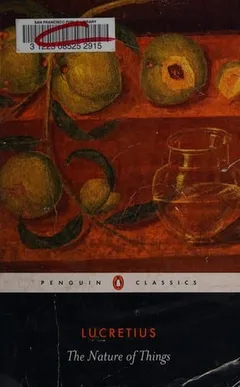
Then read Lucretius, who is the reason any of this survived culturally. On the Nature of Things is the physics in Latin hexameters and the only extended Epicurean text we have.
Correct the reputation as you go. The word epicure now means a gourmet, and the shift happened because the school’s enemies, Cicero and later Christian writers, found it convenient to describe a philosophy of pleasure as a philosophy of indulgence. The letter itself is the best refutation.
Read it against Epictetus. Both are trying to produce tranquillity, and their routes are almost opposite: the Stoic by bringing the will into line with an ordered providence, the Epicurean by denying there is any providence to align with.
Questions it raises
- Is death nothing to us? The argument only addresses being dead, and most people who fear death seem to be troubled by the loss of a future.
- If pleasure is the absence of pain, and the absence of pain is the ceiling, does anything follow about how to spend a life once you are comfortable?
- The gods exist and do nothing. Why keep them at all?
- Epicurus prefers myth to necessity because myth allows hope. Is preferring a belief for its psychological effect compatible with the rest of his method?
- The advice to live unnoticed removes the philosopher from public life. Is that prudence or abdication?
- The school admitted women and slaves and lived in a garden outside the city. How much of the philosophy is a description of that arrangement?
Highlights
Let no one delay the study of philosophy while young nor weary of it when old; for no one is either too young or too old for the health of the soul.
Paraphrase of the letter's first sentence, which frames philosophy as medicine for the mind rather than as a subject of study.
Death is nothing to us; for that which is dissolved is without sensation, and that which lacks sensation is nothing to us.
When we say that pleasure is the end and aim, we do not mean the pleasures of the prodigal or the pleasures of sensuality, as we are understood to do by some through ignorance, prejudice or wilful misrepresentation.
Of all this, the beginning and the greatest good is prudence. Therefore prudence is a more precious thing even than philosophy; from it spring all the other virtues.