Objections Against the Meditations and Replies
Assigned by 1 of the 9 reading lists
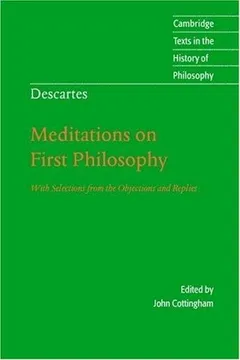
Descartes had the manuscript of the Meditations circulated before publication and printed the criticisms, with his answers, alongside it. Seven sets of objections arrive from theologians and philosophers, among them Hobbes, who denies that thinking proves an immaterial soul, Arnauld, who presses the charge that the proof of God and the proof of clear ideas argue in a circle, Gassendi, who defends the senses, and the Jesuit Bourdin, whom Descartes treats with contempt. The replies are where Descartes explains what he actually meant, often more plainly than in the Meditations themselves.
We recommendThe Philosophical Writings of Descartes, Volume 2, translated by John Cottingham, Robert Stoothoff and Dugald MurdochCambridge University Press, 1984The complete set of the seven objections with Descartes's answers, in the standard translation.
As an Amazon Associate, The Great Books earns from qualifying purchases. Bookshop.org links also support this site. How this works.
- Written
- 1641-1642
- Form
- Treatise
- Language
- Latin
- Length
- Long · 320 pp300 to 700 pages
- Difficulty
- Difficult4 of 5 for a first-year reader
John Cottingham, Robert Stoothoff and Dugald Murdoch translation
Buy on Amazon: Objections Against the Meditations and Replies, opens in a new tabBookshop.org: Objections Against the Meditations and Replies, opens in a new tab
Why it's on the list
Descartes circulated the Meditations in manuscript before publishing it, collected written objections from theologians and philosophers across Europe, and published his answers alongside the original text, producing a genuinely unusual document, a philosophical work that argues with its own most serious critics in real time within a single volume. Hobbes denies outright that Descartes's famous proof of thought establishes anything about an immaterial soul; Arnauld presses the single most damaging technical objection the Meditations has ever faced, that Descartes's proof of God's existence and his proof that clear and distinct ideas are reliable each depend on the other, a circle later philosophers have never fully resolved; Gassendi defends the senses against Descartes's skepticism with real persistence. Descartes's replies, often considerably clearer and more direct than the Meditations' own careful, staged uncertainty, are where a reader discovers what Descartes actually meant by his most famous and most contested claims, tested immediately against the sharpest objections his own contemporaries could raise.
Key themes
- Knowledge and truth
- Arnauld's objection, that Descartes's proof of God depends on trusting clear and distinct ideas while his proof that those ideas are reliable depends on God's existence already being established, remains the most influential and least resolved criticism raised against the Meditations.
- The self and identity
- Hobbes directly challenges Descartes's inference from the fact of thinking to the existence of an immaterial thinking substance, arguing that a material thing could equally well be the subject that thinks, a challenge Descartes's reply addresses without fully satisfying later materialist philosophy.
- God and faith
- Several of the seven sets of objections, particularly from theologians like Caterus, press Descartes on whether his proofs of God's existence actually meet scholastic theological standards of rigor, testing his metaphysics against an established tradition he was self-consciously trying to move beyond.
- Reason and passion
- Gassendi's objections defend a more empiricist confidence in sensory experience against Descartes's methodical doubt, an exchange that previews the centuries-long philosophical division between rationalist and empiricist approaches to knowledge that would organize much of subsequent early modern philosophy.
Which translation to read
Our pick
The Philosophical Writings of Descartes, Volume 2, translated by John Cottingham, Robert Stoothoff and Dugald Murdoch
Cambridge University Press, 1984
The complete set of the seven objections with Descartes's answers, in the standard translation.
Amazon: the John Cottingham, Robert Stoothoff and Dugald Murdoch translation, opens in a new tabBookshop.org: the John Cottingham, Robert Stoothoff and Dugald Murdoch translation, opens in a new tab
Overview
About three hundred and twenty pages, an unusual and genuinely valuable philosophical document assembled by René Descartes between 1641 and 1642, consisting of seven sets of written objections to his Meditations on First Philosophy, gathered from theologians and philosophers across Europe after Descartes deliberately circulated the manuscript before its formal publication, together with his own written replies to each set, published alongside the original text rather than separately. The resulting volume gives readers something the Meditations alone cannot provide: a direct, real-time record of Descartes’s most serious contemporary critics pressing him on specific technical difficulties, and Descartes’s own attempt to clarify, defend or occasionally simply dismiss their objections.
The seven objectors vary considerably in philosophical temperament and in how seriously Descartes himself treated their criticisms: they include the theologian Caterus, the Jesuit priest and philosopher Mersenne who coordinated much of the process, the philosopher Thomas Hobbes, whose materialist objections Descartes found genuinely challenging even while disagreeing with them, the Jansenist theologian Antoine Arnauld, whose fourth set of objections is widely regarded as containing the single most damaging technical criticism ever raised against Descartes’s system, the atomist philosopher Pierre Gassendi, who mounted a sustained, often sarcastic defense of sensory knowledge against Cartesian doubt, a group of theologians and philosophers, and finally the Jesuit Pierre Bourdin, whose objections Descartes treated with unusually open contempt, judging them confused and hostile rather than genuinely philosophically engaged.
The argument
Hobbes and materialism. Hobbes’s objections, forming the third set, directly challenge the inference at the heart of Descartes’s cogito argument, that the fact of thinking establishes the existence of an immaterial thinking substance distinct from the body. Hobbes argues that a material subject might equally well be what does the thinking, so that Descartes’s famous argument, properly examined, establishes only that thinking is occurring, not that an immaterial soul is what is doing it. Descartes’s reply insists that Hobbes has misunderstood what the relevant stage of the Meditations actually claims to prove, an exchange that anticipates, in compressed form, centuries of subsequent debate between dualist and materialist accounts of mind.
Arnauld and the Cartesian circle. Arnauld’s fourth set of objections raises what has become the most persistently discussed technical difficulty in Descartes’s entire philosophical system, an apparent circularity at the core of his argument: Descartes’s proof of God’s existence appears to rely on trusting his own clear and distinct ideas as reliable, while his argument that clear and distinct ideas are reliable appears to depend on having already established God’s existence and non-deceiving nature. This objection, known ever since as the Cartesian circle, has never been fully or uncontroversially resolved, and remains a central topic in scholarly discussion of Descartes’s philosophy to this day.
Gassendi and the defense of the senses. Gassendi’s fifth set of objections, considerably longer and more sustained than most of the others, mounts an extended defense of ordinary sensory knowledge against what Gassendi considers Descartes’s excessive and ultimately unjustified methodical doubt, addressing Descartes throughout with the pointed, repeated sarcastic address O Flesh, mocking what Gassendi presents as Descartes’s overly abstract dismissal of the body and the senses as sources of genuine knowledge. This exchange previews the broader early modern philosophical division between rationalist confidence in reason alone and empiricist insistence on the primacy of sensory experience.
Theological objections. Several objectors, particularly the theologian Caterus in the first set, press Descartes on whether his proofs of God’s existence actually satisfy established scholastic standards of theological and logical rigor, testing his explicitly innovative metaphysics against a tradition Descartes was self-consciously trying to move beyond while still needing, for both intellectual and practical reasons, to avoid open conflict with church authority.
Bourdin and open contempt. The seventh and final set of objections, from the Jesuit Pierre Bourdin, produced Descartes’s least measured and most openly hostile response among all his replies, accusing Bourdin of fundamentally failing to understand the Meditations’ basic argumentative method before attacking it, a notably testy exchange that stands in sharp contrast to the more careful, respectful tone Descartes maintains in his replies to Hobbes, Arnauld and Gassendi.
How to read it
Read each set of objections immediately alongside its corresponding reply rather than reading all seven objections consecutively before turning to Descartes’s answers; the volume’s real value lies in this direct, point-by-point exchange, and reading objection and reply together preserves the argumentative structure Descartes and his objectors were actually engaged in.
Pay particularly close attention to Arnauld’s circularity objection and Descartes’s reply to it, since this remains the single most philosophically consequential exchange in the entire volume, and forming your own judgment about whether Descartes’s response genuinely resolves the difficulty is one of the more rewarding interpretive challenges the text offers.
Notice how much more direct and plainly stated Descartes’s replies often are compared to the Meditations’ own carefully staged, deliberately uncertain first-person narrative voice; pressed to defend specific claims against specific objections, Descartes frequently states more clearly here what he actually meant than the Meditations’ own rhetorical structure allowed him to state there.
Compare the noticeably different tones Descartes adopts across his various replies, measured and genuinely engaged with Hobbes and Arnauld, sharply sarcastic in exchange with Gassendi, openly contemptuous toward Bourdin, and consider what these varying tones suggest about which objections Descartes actually considered philosophically serious versus which he judged simply confused or hostile.
Read this volume as a genuine model for how rigorous philosophical argument can proceed through direct confrontation with the strongest available objections, a method Descartes himself deliberately invited by circulating his manuscript for criticism before publication rather than simply presenting his conclusions as settled and beyond challenge.
Questions it raises
- Does Descartes’s reply to Arnauld’s circularity objection genuinely resolve the apparent circle between proving God’s existence and trusting clear and distinct ideas, or does the objection remain, as many later philosophers have concluded, a real and unresolved weakness in his system?
- How persuasive is Hobbes’s materialist challenge to the cogito argument, that a material subject might equally well be what does the thinking? Does Descartes’s reply adequately address this challenge, or does it merely restate his original position without genuinely engaging Hobbes’s objection?
- What does the markedly different tone Descartes adopts across his various replies, respectful engagement with some objectors, open contempt for Bourdin, suggest about how he distinguished between objections he considered genuinely serious and those he dismissed as confused or hostile?
- Gassendi’s sustained defense of sensory knowledge anticipates the later rationalist-empiricist divide in early modern philosophy. How does encountering this division in its original, direct confrontational form change a reader’s understanding of that later, more developed philosophical debate?
- What does the existence of this volume, an author inviting and then publishing serious criticism of his own central work alongside that work itself, suggest about Descartes’s own confidence in his system, compared to a philosopher who might have preferred to present conclusions without exposing them to direct contemporary challenge?
- Given how much clearer some of Descartes’s replies are compared to the Meditations’ own careful, staged first-person uncertainty, what does this suggest about the different demands and constraints operating on a meditative philosophical narrative compared to direct argumentative defense against specific objections?
Highlights
Hobbes objects that from the fact that I am a thinking thing, it does not follow that thought requires an immaterial substance distinct from body, since a material subject might just as well be what does the thinking, and Descartes's reply insists the objection has missed what the Meditations actually claims to prove at this stage.
Paraphrase of Hobbes's central materialist challenge to Descartes's cogito argument and Descartes's characteristically terse response.
Arnauld presses Descartes on an apparent circle, that the certainty of clear and distinct ideas seems to depend on first proving God's existence and non-deception, while the proof of God's existence itself seems to depend on trusting clear and distinct ideas already.
Paraphrase of the Cartesian circle objection, still discussed as one of the most serious unresolved difficulties in Descartes's entire system.
Gassendi addresses Descartes throughout his objections not as mind but repeatedly as O Flesh, a pointed, sustained sarcasm directed at what Gassendi considers Descartes's excessive and ultimately unjustified distrust of the senses.
Paraphrase of Gassendi's persistent, deliberately provocative rhetorical strategy throughout his lengthy set of objections.
Answering the Jesuit Bourdin, whose objections Descartes judged confused and hostile rather than genuinely engaged, Descartes responds with unusually open contempt, accusing Bourdin of failing to understand the Meditations' basic method before attacking it.
Paraphrase of the notably testy exchange between Descartes and Bourdin, in contrast to the more measured tone of his replies to other objectors.