The Meaning of Relativity
Assigned by 1 of the 9 reading lists
The text of four lectures Einstein gave at Princeton in May 1921, the most concise technical statement of his theory that he ever wrote himself, addressed to readers who could actually follow the mathematics rather than to a general audience. It moves from the space and time of pre-relativity physics through the special theory's reworking of simultaneity to the general theory and its field equations, using tensor calculus throughout rather than conceptual paraphrase. Later editions added appendices on cosmology and on his continuing attempts at a unified field theory, the last written in the final year of his life.
We recommendThe Meaning of Relativity, translated by Edwin Plimpton AdamsPrinceton University Press, 2005The fifth edition, with the appendices Einstein added up to 1954 and an introduction by Brian Greene.
As an Amazon Associate, The Great Books earns from qualifying purchases. Bookshop.org links also support this site. How this works.
- Written
- 1922
- Language
- German
- Length
- Short · 170 ppunder 120 pages
- Difficulty
- Formidable5 of 5 for a first-year reader
Edwin Plimpton Adams translation
Buy on Amazon: The Meaning of Relativity, opens in a new tabBookshop.org: The Meaning of Relativity, opens in a new tab
Why it's on the list
This is Einstein's own most concise technical statement of relativity theory, the four lectures he delivered at Princeton in 1921, and unlike the popular accounts he and others wrote for general readers, it uses the full mathematical apparatus relativity actually requires, giving readers who can follow it the theory closer to its native language than to translation. The book moves in careful sequence from the space and time of pre-relativistic physics through special relativity's reworking of simultaneity to general relativity's far more demanding claim that gravity is not a force acting through space but a curvature of space and time produced by mass and energy, worked out through field equations in essentially the form Einstein originally derived them. Later editions, with material added right up to the final year of his life, track his continuing, ultimately unsuccessful pursuit of a unified field theory, a rare quality among scientific classics, a technical record of its author's thinking still developing decades after the theory's original formulation.
Key themes
- Nature and the cosmos
- The general theory's central claim, that gravity is not a force acting across space but a curvature of space and time itself produced by mass and energy, replaces Newtonian gravitational force with a geometric account of the universe's actual structure, presented here through Einstein's own original field equations.
- Science and method
- Einstein moves from the space and time assumptions of pre-relativistic physics through special relativity's reworking of simultaneity to general relativity's far more demanding geometric framework, modeling how a physical theory can be built through sequential extension of prior assumptions.
- Knowledge and truth
- Written in the full technical language of tensor calculus rather than in popular translation, the book gives readers capable of following the mathematics access to relativity in something closer to its original derivation than the looser conceptual accounts written for general audiences.
Which translation to read
Our pick
The Meaning of Relativity, translated by Edwin Plimpton Adams
Princeton University Press, 2005
The fifth edition, with the appendices Einstein added up to 1954 and an introduction by Brian Greene.
Amazon: the Edwin Plimpton Adams translation, opens in a new tabBookshop.org: the Edwin Plimpton Adams translation, opens in a new tab
Overview
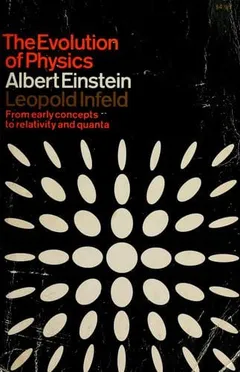
About a hundred and seventy pages, the published text of four lectures Albert Einstein delivered at Princeton University in May 1921, generally regarded as the most concise and most technically direct statement of relativity theory Einstein himself ever wrote, distinguishing it sharply from the popular, non-mathematical accounts, including The Evolution of Physics written later with Leopold Infeld, that Einstein and others produced for general audiences. Where those popular accounts translate relativity into conceptual explanation and analogy, this book presents the theory using its actual mathematical apparatus, tensor calculus throughout, giving readers capable of following the mathematics access to something considerably closer to relativity’s original technical derivation rather than to a necessarily looser conceptual paraphrase.
The book moves through relativity’s development in careful, deliberate sequence, from the assumptions of pre-relativistic physics regarding space and time, through the special theory of relativity’s reworking of simultaneity and measurement, to the general theory of relativity’s considerably more demanding claim that gravitation itself should be understood not as a force acting across space but as curvature of space and time produced directly by the presence of mass and energy, developed through the field equations Einstein presents here in essentially the same technical form he had originally derived them.
The argument
Space and time before relativity. Einstein opens by carefully examining and dismantling the assumptions regarding absolute space and absolute time that had organized classical, pre-relativistic physics, showing how these apparently self-evident concepts actually depend on unexamined assumptions about simultaneity, the notion that two distant events can be meaningfully said to occur at exactly the same moment, assumptions that break down once the finite, constant speed of light is properly incorporated into physical theory.
Special relativity. Building on this foundation, Einstein develops the special theory of relativity, showing how accepting the constancy of the speed of light for all observers, regardless of their own relative motion, requires abandoning absolute simultaneity and absolute space and time in favor of a framework in which measurements of length, time and simultaneity themselves depend on an observer’s relative motion, a genuinely counterintuitive conclusion Einstein derives here through careful, sequential mathematical argument rather than through the more purely conceptual thought experiments his popular writing typically employs.
General relativity and curved spacetime. The book’s later lectures develop the considerably more demanding general theory of relativity, extending special relativity’s framework to include gravitation and accelerated motion, and arriving at the theory’s central and most conceptually radical claim: that gravitational effects are not produced by a force acting at a distance across space, as Newtonian physics had held, but by the actual curvature of space and time itself, curvature produced directly by the presence of mass and energy, with objects moving under gravitational influence understood as simply following the straightest available paths through this curved geometric structure rather than being pulled by any separate gravitational force.
Field equations. Einstein presents the general theory’s central field equations, the precise mathematical relationship connecting the distribution of mass and energy to the resulting curvature of spacetime, in essentially their original technical form, giving readers capable of following tensor calculus direct access to the actual mathematical machinery underlying general relativity’s predictions rather than to a simplified conceptual summary of its conclusions alone.
Later appendices and unified field theory. Subsequent editions of the book, expanded across the decades following its original 1922 publication and including material added as late as the final year of Einstein’s own life, incorporate additional appendices addressing cosmological applications of general relativity and documenting Einstein’s own continuing, ultimately unsuccessful pursuit of a unified field theory capable of describing gravitation and electromagnetism within a single, more comprehensive mathematical framework, giving the book’s later editions a genuinely unusual quality among scientific classics, a technical record of its author’s own thinking still actively developing decades after the theory’s original formulation.
How to read it
Approach this book with realistic expectations about its mathematical demands; unlike Einstein’s popular writing, this text assumes genuine familiarity with tensor calculus and related mathematical apparatus, and readers without this background will find considerably more accessible entry points into relativity through Einstein’s own more conceptual writing or through dedicated popular expositions.
Read the opening dismantling of pre-relativistic assumptions about space and time as the necessary logical foundation for everything that follows; special and general relativity’s more startling later conclusions only make full sense once the classical assumptions they replace have been carefully and explicitly identified and set aside.
Pay particular attention to how general relativity’s central claim, gravity as spacetime curvature rather than force, represents a genuinely different kind of explanation than Newtonian gravitational theory provided, a geometric rather than a force-based account of the same physical phenomena, and consider what this shift in explanatory type, rather than merely in specific predictions, actually accomplishes.
Notice how the later appendices, tracking Einstein’s continuing and ultimately unsuccessful pursuit of a unified field theory, give this book a genuinely unusual historical quality, documenting not a finished, settled theoretical achievement but an author’s own extended, incomplete further inquiry pursued across the remaining decades of his working life.
Read this book alongside Einstein’s more accessible popular writing, particularly The Evolution of Physics, to compare directly what technical mathematical presentation preserves and conveys that conceptual, non-mathematical explanation necessarily cannot fully capture, and to appreciate the genuine difference between these two modes of presenting the same underlying physical theory.
Questions it raises
- What is actually gained by engaging with relativity theory in its original technical, mathematical form, as this book presents it, compared to encountering the same theory through conceptual, non-mathematical explanation in more popular accounts? Does the mathematics convey something popular explanation genuinely cannot?
- How does general relativity’s geometric reconception of gravity, as spacetime curvature rather than force, compare as a mode of physical explanation to Newton’s earlier force-based account of the same phenomena? Does this shift represent simply a more accurate description, or a genuinely different way of understanding what physical explanation itself requires?
- What does Einstein’s own continuing, ultimately unsuccessful pursuit of a unified field theory, documented in this book’s later appendices, suggest about the relationship between a scientist’s greatest achieved success and their subsequent, unresolved further ambitions?
- How should a reader without strong mathematical background approach a book this technically demanding? Does attempting to follow the general argument and conceptual structure, even without fully grasping the mathematical derivations, still provide genuine value, or does the technical apparatus create too significant a barrier?
- Given that Einstein wrote both this technical presentation and considerably more accessible popular accounts of the same theory, what does this suggests about his own view of the relationship between technical and popular scientific communication, and which form did he seem to consider more fundamentally authoritative?
- The book’s later editions incorporate material added across several decades, including cosmological applications developed considerably after the theory’s original 1921 formulation. How does tracking this extended development change a reader’s understanding of relativity as a completed theory versus an ongoing, still-developing framework?
Highlights
Einstein begins by carefully dismantling the assumptions of pre-relativistic physics regarding absolute space and absolute time, showing how these apparently self-evident concepts actually depend on unexamined assumptions about simultaneity that break down once the finite speed of light is properly taken into account.
Paraphrase of Einstein's opening dismantling of classical assumptions about absolute space and time, the necessary foundation before introducing special relativity's alternative.
He derives the general theory's central claim that gravitational effects are not produced by a force acting across space but by the curvature of space and time itself, curvature produced directly by the presence of mass and energy, and that objects moving under gravity's influence are actually following the straightest possible paths through this curved geometric structure.
Paraphrase of Einstein's central geometric reformulation of gravity, the general theory's most fundamental and most conceptually demanding claim.
The later appendices, added across subsequent decades and including material from the final year of Einstein's life, document his continuing, ultimately unsuccessful attempts to develop a unified field theory capable of describing gravitation and electromagnetism within a single mathematical framework.
Paraphrase of the book's later additions tracking Einstein's own extended, unresolved pursuit of a unified theory beyond general relativity.