On the Heavens
by Aristotle · Περὶ οὐρανοῦ
Assigned by 1 of the 9 reading lists, catalogue entry only
- Written
- c. 350 BCE
- Form
- Treatise
- Language
- Greek
- Length
- Short · 110 ppunder 120 pages
- Difficulty
- Difficult4 of 5 for a first-year reader
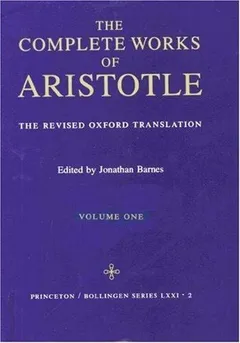
We recommendThe Complete Works of Aristotle, Volume 1, translated by Jonathan Barnes (ed.)Princeton University Press, 1984The revised Oxford translation, in the same volume as the Physics it continues.
These links go straight to Amazon and Bookshop.org and earn this site nothing today. Prices are the same either way. How this works.
Aristotle's cosmology. Books I and II argue that the heavens are made of a fifth element, aether, which moves naturally in a circle and cannot be generated or destroyed, that the universe is finite, unique and eternal, and that the earth is a sphere at rest at its centre. Books III and IV turn to the four sublunary elements, their natural motions up and down, and the meaning of heavy and light. This was the physics of the cosmos until Copernicus and Galileo.
No reading guide yet
The catalogue entry above is complete: the dates, the form, the themes and every program that assigns On the Heavens are verified against each program's published list.
What is missing is the part that takes real work: the summary, the key passages, and a recommended translation. The edition named below is the one most programs assign, so the buy links are useful already.