Principles of Nature and Grace
by Gottfried Wilhelm Leibniz · Principes de la nature et de la grâce fondés en raison
Assigned by 1 of the 9 reading lists
A short summary of Leibniz's mature philosophical system in eighteen paragraphs, written in 1714 for Prince Eugene of Savoy as a companion piece to the Monadology, composed that same year. It introduces monads and their perceptions, distinguishes souls from minds, and states the principle of sufficient reason before asking why there is something rather than nothing. The answer is God, who has chosen the most perfect world, and the essay closes with the moral world of minds understood as a City of God operating under both nature and grace.
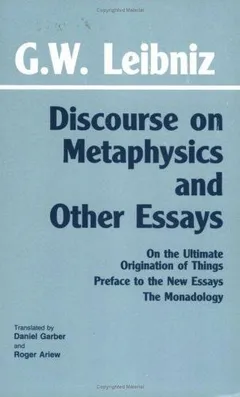
We recommendDiscourse on Metaphysics and Other Essays, translated by Daniel Garber and Roger AriewHackett, 1991Prints this short summary next to the Monadology it was written alongside.
As an Amazon Associate, The Great Books earns from qualifying purchases. Bookshop.org links also support this site. How this works.
- Written
- 1714
- Form
- Treatise
- Language
- French
- Length
- Short · 10 ppunder 120 pages
- Difficulty
- Demanding3 of 5 for a first-year reader
Daniel Garber and Roger Ariew translation
Buy on Amazon: Principles of Nature and Grace, opens in a new tabBookshop.org: Principles of Nature and Grace, opens in a new tab
Why it's on the list
Leibniz wrote this short summary specifically for Prince Eugene of Savoy, a practical audience of one rather than the broader philosophical readership his other work often addressed, and the resulting compression forces his mature system into eighteen paragraphs a busy statesman could actually absorb. Introducing monads and their perceptions, distinguishing simple souls from the more reflective minds capable of self-knowledge, and stating the principle of sufficient reason as a working method, the essay builds toward its central question, why there is something rather than nothing, a question Leibniz treats as demanding an actual answer. His answer, God choosing the most perfect world according to that same principle, connects the essay's metaphysics to its closing theological vision, the moral world of minds as a City of God operating under both nature and grace, mechanical and moral order interlocking rather than competing. Written as a companion to the Monadology, composed the same year, this shorter essay shows how compactly Leibniz's system could be stated once necessity required it.
Key themes
- Nature and the cosmos
- The essay introduces monads and their perceptions as Leibniz's fundamental metaphysical units, distinguishing simple souls from more reflective minds capable of self-knowledge, compressing his mature theory of substance into a form a busy, non-specialist reader could actually absorb.
- God and faith
- Leibniz answers why there is something rather than nothing by pointing to God, who has chosen the most perfect world according to sufficient reason, connecting the essay's metaphysics directly to its closing theological vision of a moral world operating under both nature and grace.
- Knowledge and truth
- The essay states the principle of sufficient reason as a working method rather than abstract slogan, using it to structure the entire argument's progression from monads and perception through to the ultimate metaphysical question the essay poses and answers.
- The self and identity
- Leibniz's distinction between simple souls and more reflective minds capable of self-knowledge addresses directly what distinguishes genuine selfhood from mere perception, a compressed but consequential move within the essay's broader account of monadic hierarchy.
Which translation to read
Our pick
Discourse on Metaphysics and Other Essays, translated by Daniel Garber and Roger Ariew
Hackett, 1991
Prints this short summary next to the Monadology it was written alongside.
Amazon: the Daniel Garber and Roger Ariew translation, opens in a new tabBookshop.org: the Daniel Garber and Roger Ariew translation, opens in a new tab
Overview
About ten pages, a short summary of Leibniz’s mature philosophical system in eighteen paragraphs, written in 1714 for Prince Eugene of Savoy as a companion piece to the Monadology, composed the same year. Addressed to a genuinely practical audience of one, a busy statesman rather than a professional philosophical readership, the essay compresses Leibniz’s characteristically intricate system into a form its intended reader could actually absorb.
The essay introduces monads and their perceptions, distinguishes souls from minds, and states the principle of sufficient reason before asking why there is something rather than nothing. The answer is God, who has chosen the most perfect world, and the essay closes with the moral world of minds as a City of God under nature and grace.
What happens
Introducing monads and their perceptions. The essay opens by introducing monads and their perceptions as the fundamental units of Leibniz’s metaphysical system, establishing in compressed form the basic building blocks his broader philosophy depends on throughout its subsequent argument.
Distinguishing souls from minds. Leibniz distinguishes simple souls, which merely perceive, from more reflective minds capable of genuine self-knowledge and awareness of necessary truths, a hierarchical distinction that structures how different kinds of monads relate to and understand their own existence.
Stating the principle of sufficient reason. Leibniz states the principle of sufficient reason, that nothing occurs without a reason why it is so and not otherwise, presenting this not as abstract philosophical slogan but as an actual working method the essay’s subsequent argument will directly apply.
Why there is something rather than nothing. Building on the principle of sufficient reason, Leibniz poses the essay’s central metaphysical question, why there is something rather than nothing, treating this as a question genuinely demanding an answer rather than functioning as mere rhetorical flourish.
God and the most perfect world. Leibniz answers his own central question by pointing to God, who has chosen to create the most perfect world possible according to the same principle of sufficient reason that structures the essay’s entire preceding argument.
The City of God under nature and grace. The essay closes with a vision of the moral world of minds as a City of God, operating simultaneously under nature’s mechanical order and grace’s moral order, these two systems interlocking rather than competing within Leibniz’s overall theological and metaphysical vision.
How to read it
Read this essay as a genuine companion piece to the Monadology rather than a fully independent work; composed the same year for a related but distinct purpose, the two texts illuminate each other directly, with this shorter essay’s compression revealing how efficiently Leibniz could state his system once necessity required it.
Pay close attention to how the essay’s intended audience, a busy statesman rather than a professional philosopher, shapes its actual structure; the compression into eighteen paragraphs is not simplification for its own sake but a genuine test of how compactly Leibniz’s intricate system could be communicated to someone without extensive philosophical training.
Notice how directly the principle of sufficient reason structures the essay’s progression toward its central question; Leibniz does not simply assert this principle abstractly but uses it as an actual working tool to derive the question of why anything exists at all, and then to derive his answer.
Consider the closing vision of the City of God under nature and grace as genuinely integrating rather than merely juxtaposing two different orders; nature’s mechanical causation and grace’s moral order operate together within Leibniz’s system rather than existing as separate, potentially conflicting domains.
Read this essay alongside Leibniz’s own Monadology, composed as its direct companion, to see how the same underlying system receives two different treatments, this shorter essay’s practical compression against the Monadology’s more purely philosophical, systematic exposition of the same core concepts.
Questions it raises
- Does the essay’s genuine compression into eighteen paragraphs successfully preserve the philosophical substance of Leibniz’s broader system, or does addressing a non-specialist reader necessarily require sacrificing some of the nuance and argumentative rigor his longer works develop more fully?
- How persuasive is Leibniz’s answer to why there is something rather than nothing, that God has chosen the most perfect world according to sufficient reason? Does this answer actually resolve the question, or does it simply relocate the underlying mystery onto God’s own reasons for choosing as he did?
- What does the distinction between simple souls and more reflective minds suggest about how Leibniz understood the relationship between perception and genuine self-awareness? Does this hierarchical distinction hold up as a coherent account of different levels of mental life?
- How does writing specifically for Prince Eugene of Savoy, a practical statesman rather than a philosopher, shape the essay’s rhetorical choices and emphases compared to Leibniz’s more purely academic philosophical writing? Does this intended audience explain specific features of the text’s structure or content?
- Given that this essay and the Monadology were composed the same year as companion pieces, what does comparing them directly reveal about how Leibniz adapted the same underlying philosophical content for different purposes and audiences? Does one version illuminate aspects the other leaves less developed?
- What does the closing image of the City of God under nature and grace suggest about Leibniz’s broader attempt to reconcile mechanical scientific explanation with moral and theological meaning? Does this integration succeed, or does it paper over genuine tensions between these two different kinds of order?
Highlights
Leibniz introduces monads and their perceptions as the fundamental units of his metaphysical system, distinguishing simple souls, which merely perceive, from more reflective minds capable of genuine self-knowledge and awareness of necessary truths.
Paraphrase of the essay's opening metaphysical distinctions, compressing Leibniz's broader theory of substance into compact form.
Leibniz states the principle of sufficient reason, that nothing occurs without a reason why it is so and not otherwise, and uses this principle directly to pose and then answer the essay's central question, why there is something rather than nothing.
Paraphrase of the essay's central methodological and metaphysical turn, using sufficient reason to structure its ultimate question.
Leibniz answers that God has chosen the most perfect world according to the principle of sufficient reason, and closes the essay with the moral world of minds understood as a City of God, operating under both nature's mechanical order and grace's moral order simultaneously.
Paraphrase of the essay's theological conclusion, connecting its metaphysics to a closing vision of nature and grace operating together.